Enterprise AI Is Becoming a Permission Business

Wall Street keeps framing the software trade as a simple question: will generative AI crush the old SaaS model or rescue it? The better question is who controls the enterprise once the model itself becomes easier to swap.
That is why some of the most important signals in software this month did not come from a flashy chatbot launch. They came from boring, high-friction places: workflow routing, governance, risk controls, and the right to inject trusted data into live business processes. ServiceNow said its AWS Marketplace transactions have passed $1 billion. Experian said it is embedding its Ascend decisioning platform directly into ServiceNow workflows so AI agents can act inside onboarding, third-party risk, and model-governance processes. Those are not consumer-style AI demos. They are pieces of operating infrastructure.
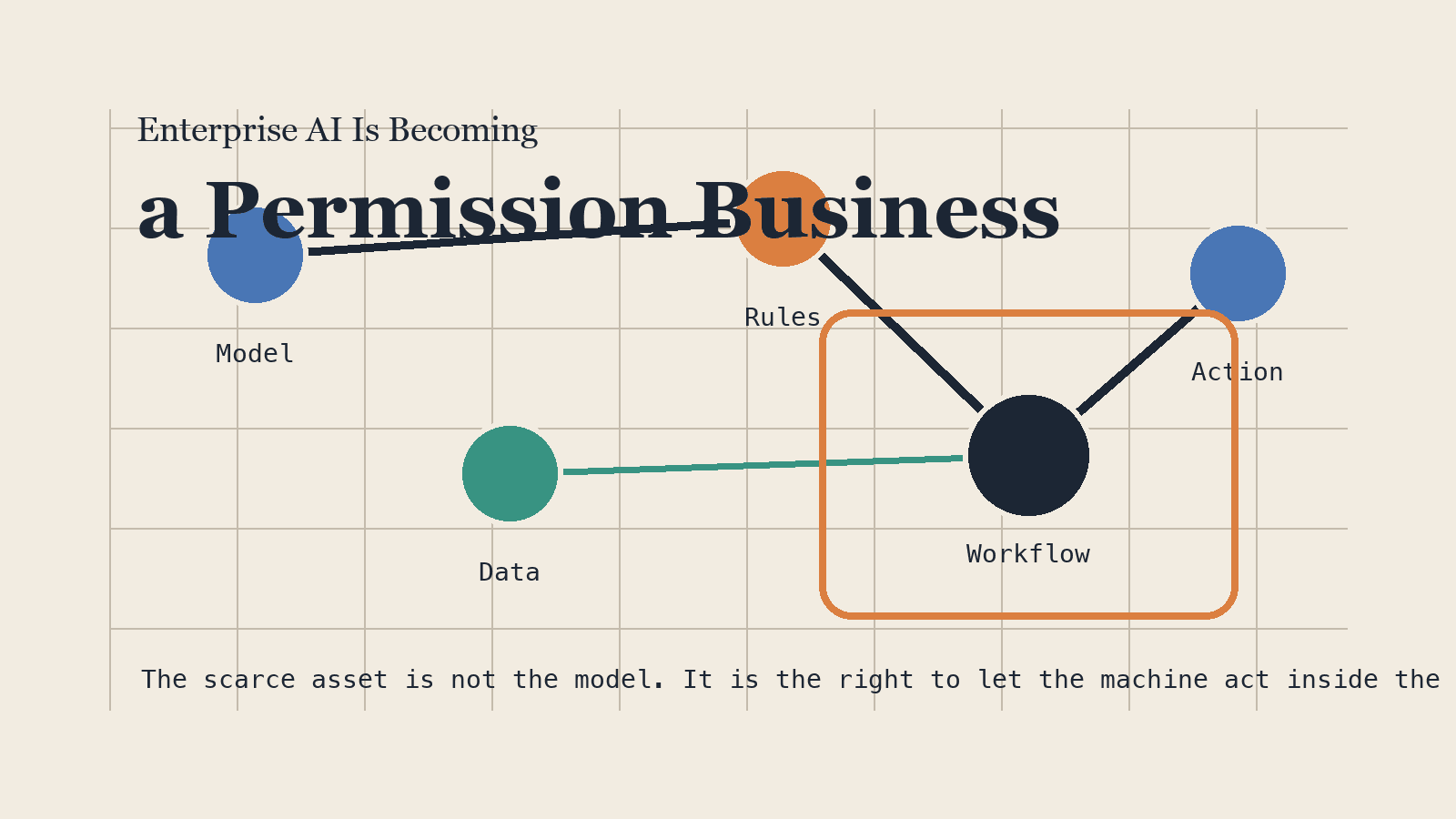
The hidden shift is that enterprise AI is becoming a permission business. The big money may not go to whichever model is smartest on a benchmark. It may go to whichever platform sits between the model and the business action, decides what data the agent can touch, records what it did, and gives management enough confidence to let automation spread beyond pilots.
That distinction matters because public investors are still trading software as if the whole group faces one AI threat. Reuters reported on May 19 that U.S. software stocks were attempting a rebound after a brutal selloff, but the sector remains damaged: the iShares Expanded Tech-Software ETF is down 12.2% this year and the S&P 500 software and services index is down 13.7%. The market is drawing a line between companies tied to old per-seat economics and those closer to the center of the AI buildout.
ServiceNow looks like one of the clearer examples of what the market is starting to reward. Its first-quarter subscription revenue rose 22% year over year to $3.67 billion. Current remaining performance obligations grew 22.5% to $12.64 billion. It also logged 16 transactions above $5 million in net new annual contract value, up nearly 80% from a year earlier, and ended the quarter with 630 customers generating more than $5 million in ACV. Those are not the numbers of a company getting disintermediated. They are the numbers of a company moving deeper into the enterprise control layer.
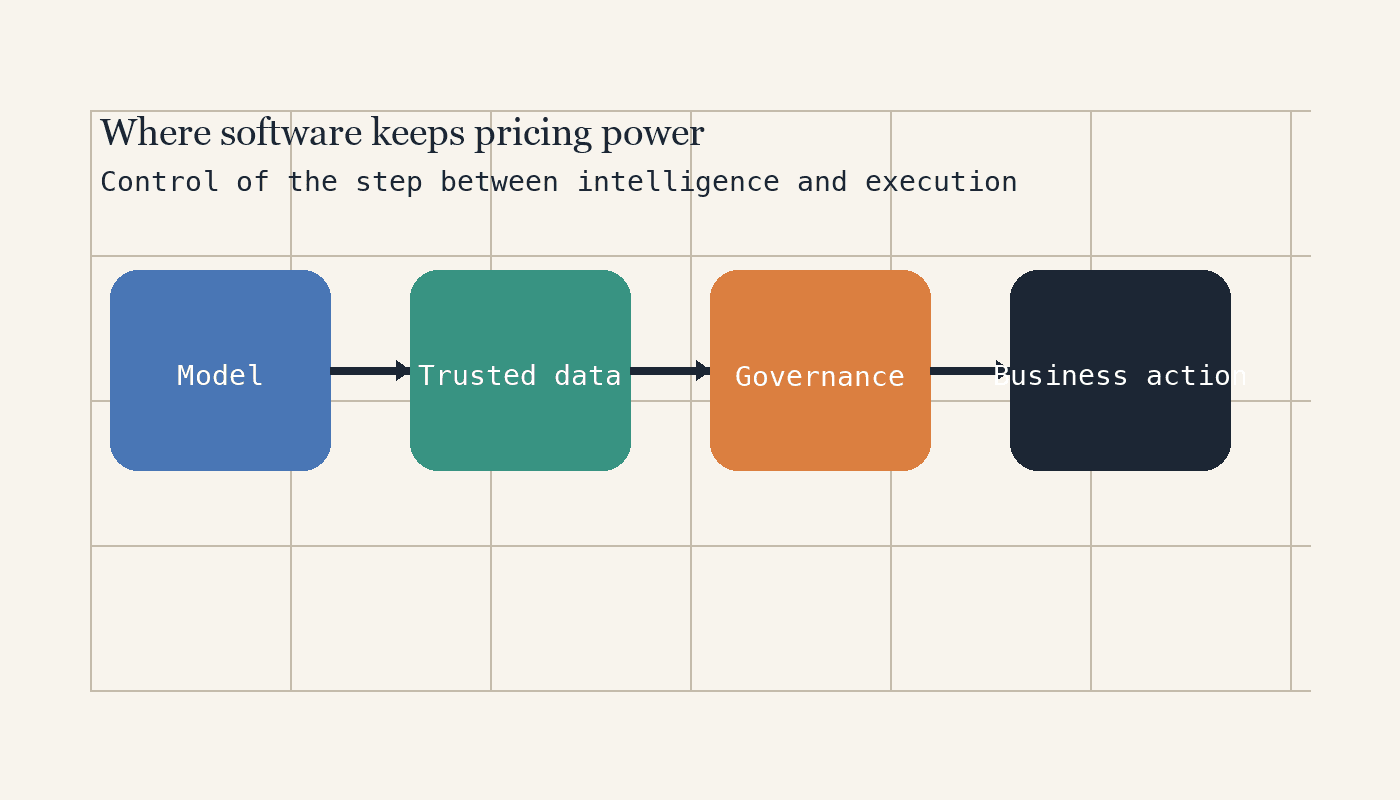
The AWS Marketplace milestone adds another clue. When software is sold through the same channel as infrastructure, governance, and model services, the boundary between application software and cloud plumbing starts to blur. That is useful for buyers, but even more useful for the vendors that become the default coordination point. Once a company wires AI agents into security operations, customer support, procurement approvals, or compliance review, the valuable product is not just the model output. It is the operating map around the model.
Experian's partnership with ServiceNow reinforces the same point from the data side. Experian said data limitations are the main barrier for eight in ten organizations trying to scale agentic AI. That is exactly why trusted data owners suddenly matter more. In an agentic system, bad data is not just a reporting problem. It becomes an action problem. If an agent is allowed to approve, escalate, route, or deny something, the data supplier and workflow governor gain more leverage than they had in the old dashboard era.
This is what casual readers are missing: enterprise software is not being split into winners and losers simply by who has an AI assistant. It is being split by who owns the last mile between intelligence and execution. Models will keep improving and costs will keep falling. That usually compresses the value of raw capability. The scarcer asset is institutional permission: who is trusted to connect the model to money movement, employee access, procurement, underwriting, customer service, and regulatory exposure without creating chaos.
That does not mean every incumbent software company is safe. Reuters noted that investors still want proof that software firms can defend margins and business models against AI pressure. Many will not. But the companies that can turn AI into governed workflow, trusted decisioning, and embedded operational control are no longer selling just software seats. They are selling the right to let the machine act. In this market, that may be a much better business.