Micron Is Turning Memory Into a Strategic Asset

Micron's Virginia expansion this week looks easy to file under semiconductor reshoring. That is too small a read. For U.S. investors, the more important signal is that one of the least glamorous parts of the AI stack, memory, is starting to be treated like strategic capacity rather than a cyclical component business.
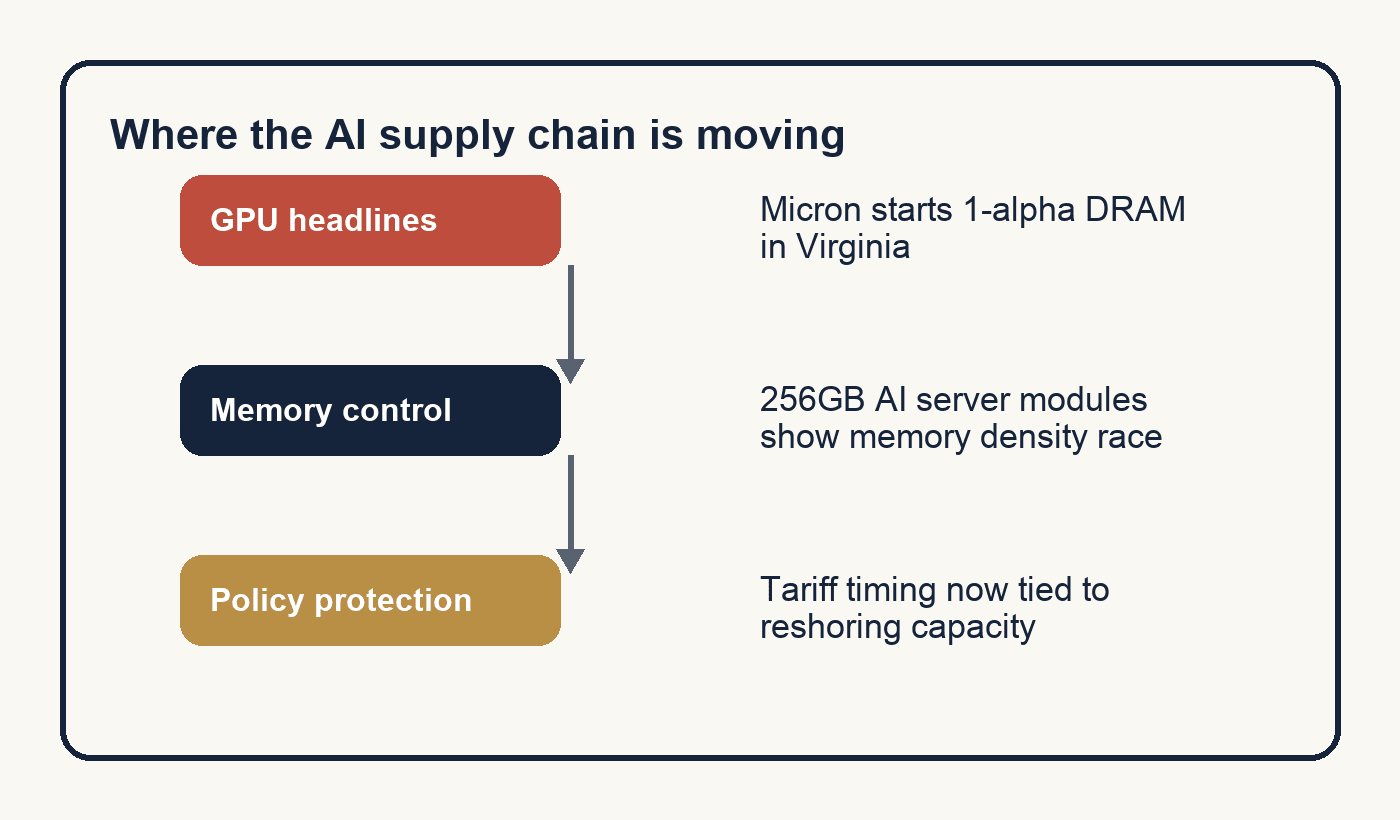
The headline facts matter. On May 22, Micron said it had started manufacturing 1-alpha DRAM at its Manassas, Virginia plant, calling it the most advanced memory ever produced in the United States. At the same event, U.S. Trade Representative Jamieson Greer said there were no immediate semiconductor tariffs coming, but stressed that protection for the sector mattered and had to be sequenced to support reshoring.
What casual readers may be missing is that this is not really a tariff story and not just a factory story. It is a clue that the AI hardware race is moving beyond GPU headlines and into control of the memory layer that makes those systems economically useful. Once Washington starts talking about timing tariffs around DRAM output, memory stops looking like a commodity and starts looking more like infrastructure.
That shift matters because memory is where a lot of the AI buildout gets less visible and more expensive. Faster models and bigger clusters do not only need more accelerators. They need more high-bandwidth memory, more dense server DRAM, and more storage that can keep huge training and inference systems fed. Micron's own recent announcements make that clear. In March, the company said its record quarterly results and outlook reflected the "strategic value of memory in the AI era." Earlier this month, it said it had sampled 256GB DDR5 server modules aimed at AI servers and key ecosystem partners.
Put differently, the market has spent most of this cycle acting as if Nvidia captures the real scarcity and everyone else supplies accessories. That view is getting weaker. If memory content per server keeps climbing and domestic supply starts to matter politically, the companies that own the constrained memory layer can gain bargaining power even if they do not dominate the narrative. Micron is not just selling bits into a generic chip market. It is positioning itself as a bottleneck supplier in a market the U.S. government increasingly wants onshore.
That has a direct business consequence. Commodity industries usually trade on the fear that excess capacity will eventually crush margins. Strategic industries trade differently. They can win subsidies, long-term customer commitments, policy protection, and a valuation premium for being hard to replace. Micron is not fully in that second category yet, and investors should not pretend Virginia suddenly rewrites the global memory market. But the direction is changing. When policymakers publicly worry about protecting domestic memory output during a "reshoring phase," they are signaling that this capacity has become economically sensitive before the supply picture is even fully rebuilt.
There is also a second-order implication for the rest of the AI trade. If memory becomes more strategic, then the capital intensity and supply-discipline advantage can broaden beyond GPUs and foundries. Hyperscalers may have to think harder about securing memory alongside compute. Enterprise buyers may find that the real cost of AI infrastructure is not only the headline accelerator price, but the full stack of constrained components around it. And public-market investors may need to stop treating memory like a sidecar to somebody else's boom.
That does not mean the old memory cycle is dead. It still can be a brutal business when inventories swell or demand cools. Government support does not eliminate cyclicality, and tariff talk can just as easily create distortion if it gets ahead of actual domestic scale. But the more revealing point is that Micron's latest move would not be getting this kind of policy choreography if memory were still viewed as a low-status input.
The sharper takeaway is that the AI buildout is forcing a re-rating of what counts as strategic semiconductor capacity. GPUs may still command the attention, but memory is starting to command the policy. If that continues, Micron and its peers will be judged less like commodity chip vendors and more like owners of a critical layer in the next industrial system.