Walmart Is Turning Consumer Stress Into Platform Profit

Walmart's latest quarter looked, on the surface, like another proof point that the American consumer is holding up. Revenue rose 7.3% in the first quarter of fiscal 2027, global eCommerce grew 26%, and U.S. comparable sales excluding fuel climbed 4.1%. That is the kind of print investors usually read as resilience.
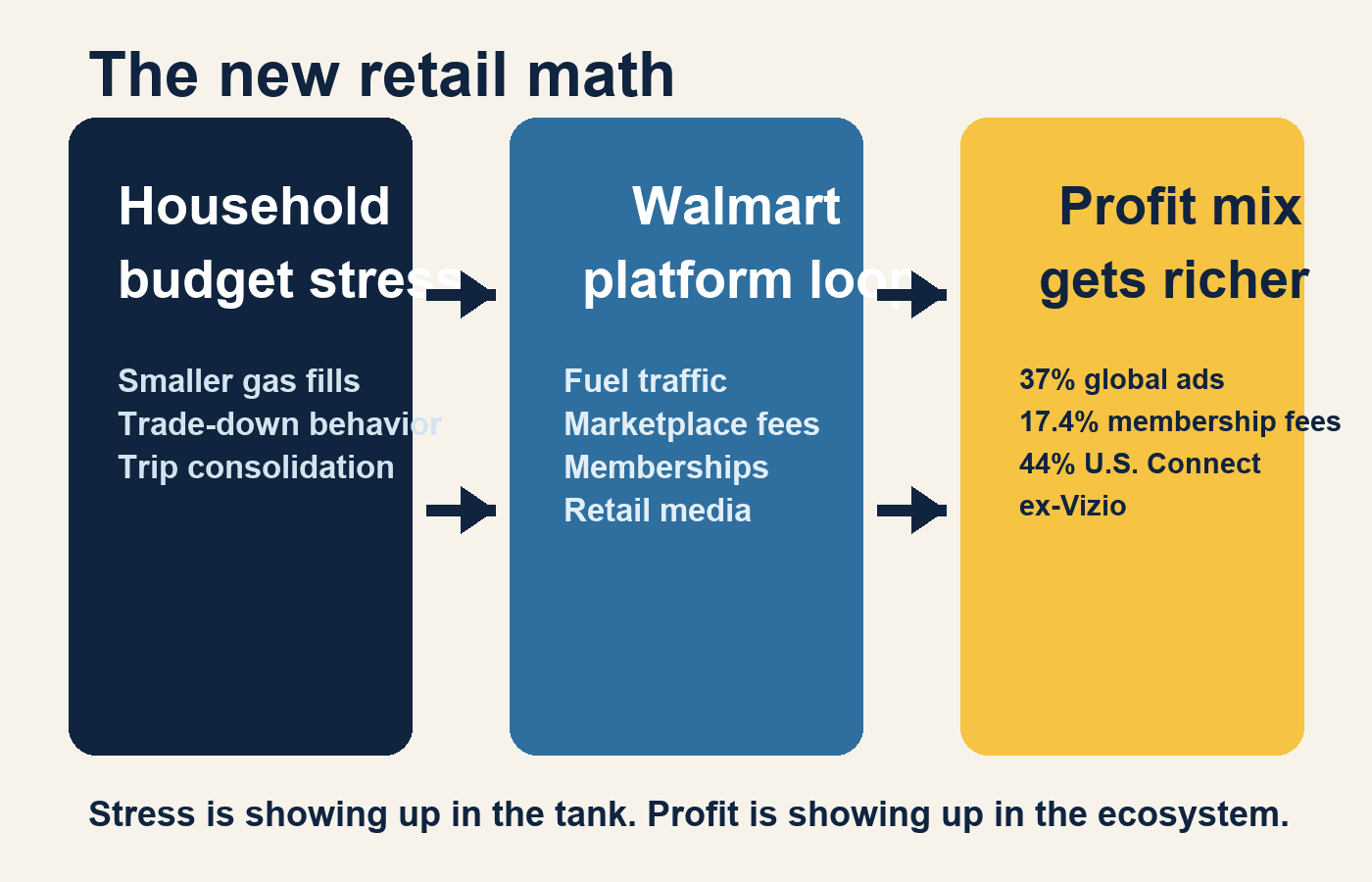
But Walmart gave away the more revealing signal on the same call. Chief financial officer John David Rainey said the average fill-up at Walmart and Sam's Club gas stations fell below 10 gallons for the first time since 2022, which he called "an indication of stress." At the same time, the University of Michigan's consumer sentiment index fell to a record low 44.8 in May, while AAA said the national average gasoline price had climbed above $4.50 heading into Memorial Day weekend.
The thing casual readers may be missing is that Walmart is no longer just reporting on the consumer. It is increasingly monetizing consumer stress. The company can absorb pressured households better than most retailers because more of its profit stack now comes from businesses built around the shopping trip, not just from the items in the cart. When shoppers trade down, consolidate trips, or chase value, Walmart can still win through advertising, memberships, marketplace services, and fuel-driven traffic.
That helps explain why the quarter felt stronger than the backdrop. Walmart's global advertising business grew 37%, and Walmart Connect in the U.S. grew 44% excluding Vizio. Global membership fee income rose 17.4%. Those are not grocery margins. They are higher-value toll booths sitting on top of a customer base that is becoming more price sensitive by the week.
This matters because it changes how investors should read big-box retail earnings. For years, Walmart was treated as a defensive store operator that did well when households got nervous. Now it is becoming something closer to a consumer platform. Delivery speed, closed-loop ad targeting, paid membership, marketplace fees, and fuel discounts all work together. A customer who comes for cheaper gas is more likely to buy groceries. A member who buys groceries is more valuable to advertisers. An advertiser paying for placement subsidizes sharper pricing, which pulls in more traffic. Stress in the household budget does not disappear in that loop. It gets captured and rerouted.
That is why Walmart's results are not a clean all-clear on U.S. spending. In fact, they may suggest the opposite. If lower-income shoppers are literally buying gasoline in smaller doses while Walmart is still gaining share, the takeaway is not that wallets are fine. It is that the strongest retailers are building business models that can profit from fragmentation in the wallet. Volume can weaken in parts of the store and the company can still defend margins because its economics are no longer tied one-for-one to merchandise markups.
The contrast with weaker retailers could get harsher from here. Companies that still rely mainly on product gross margin are exposed to the old retail math: cost inflation, promotional pressure, and fragile discretionary demand. Walmart increasingly has newer levers. It can sell the ad, collect the membership fee, process the marketplace transaction, move the order through automated fulfillment, and use fuel discounts to anchor repeat visits. That is a different kind of resilience, and it is more structural than cyclical.
There is also a broader market implication. Investors looking for the next consumer warning sign may be staring too hard at apparel chains or headline sentiment prints. One of the clearest signals may be hidden inside the business model of the biggest discount retailer in the country. When Walmart says shoppers are under stress but still posts healthy growth, that does not mean the pressure is overstated. It may mean the pressure is being transferred to everyone outside the most scaled retail ecosystems.
In other words, Walmart is becoming less of a barometer and more of a collector. It is collecting traffic from anxious households, ad dollars from brands that need that traffic, and recurring revenue from members who want protection from a more expensive economy. That is a powerful model. It is also a warning that consumer stress is no longer just a macro story. It is turning into a source of competitive advantage.