Insurance Is Becoming One of America’s Cleanest Pricing-Power Businesses

For years, investors treated personal-lines insurers as hostages to the weather and the accident cycle. This week’s numbers suggest something more important: the business is turning into one of the cleanest pricing-power stories in corporate America.
That matters because the headline narrative still sounds backward. Severe weather has not disappeared. Allstate said on May 21 that April catastrophe losses totaled $870 million before tax, with about 70% tied to just two wind and hail events. Progressive’s April combined ratio worsened from a year earlier. On the surface, that should look like the usual reminder that insurance earnings remain fragile.
But the bigger signal is that the industry is making more money anyway. Carrier Management, citing S&P Global Market Intelligence’s aggregation of NAIC filings, said U.S. property and casualty insurers posted a first-quarter combined ratio of 89.5, the best first-quarter underwriting result in at least 25 years. Casual readers may see that as a lucky quarter. What they are missing is that the real shift is operational: insurers are repricing risk faster than households can change their behavior.
Allstate’s first-quarter release made that point more clearly than any macro chart. Property-liability earned premiums rose 5.5% to $14.8 billion. Underwriting income jumped to $2.658 billion from $360 million a year earlier. Its combined ratio improved to 82.0 from 97.4. Just as important, the company was still growing. Policies in force rose 2.3%, led by auto and homeowners, while Allstate said homeowners average gross written premium rose 6.8% because of continued rate increases and higher replacement costs.
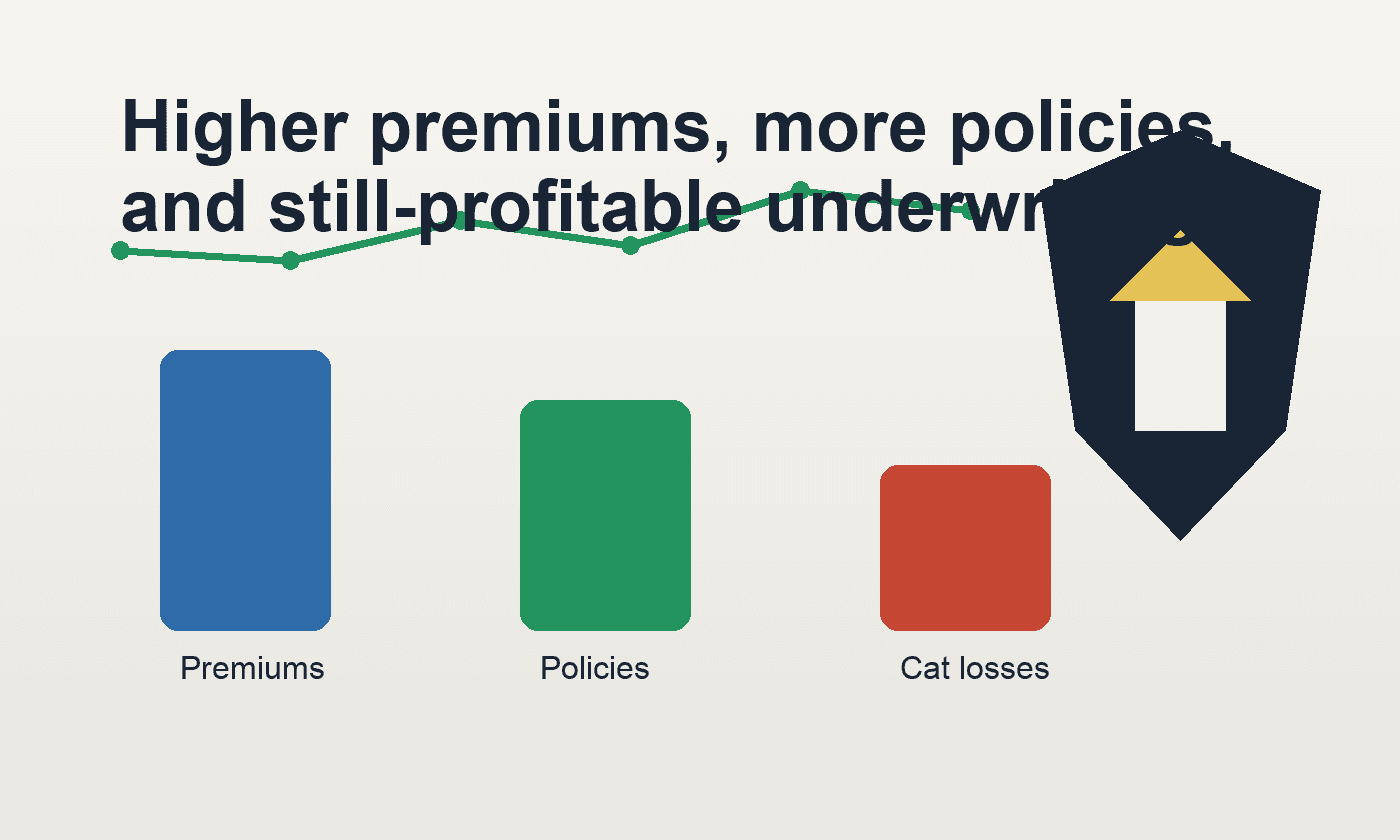
Progressive’s April update tells a similar story with slightly messier monthly noise. Net premiums written rose 6% to $7.278 billion, net income rose 10% to $1.087 billion, and total policies in force climbed 8% from a year earlier. Yes, the April combined ratio of 90.2 was worse than last year’s 84.9. But a 90 handle is still profitable underwriting, and it came alongside continued customer growth.
That combination is the part the market cares about. If customers were truly revolting against price increases, policy counts would be cracking. Instead, the big carriers are showing they can raise rates, refine underwriting, market aggressively, and still add business. Allstate explicitly said market share increased in many states because of a broader toolkit that included pricing, product design, bundled offerings, lower expenses, analytics, and more marketing. In plain English: this is no longer just an actuarial business. It is a distribution-and-data business with insurance wrapped around it.
The second-order implication is bigger than insurer earnings. Personal auto and homeowners coverage are increasingly functioning like privately administered inflation passthroughs. When repair costs, replacement values, storm losses, or bodily injury severity rise, carriers do not simply absorb the hit and hope for better luck next year. The stronger ones now have enough pricing infrastructure and segmentation to push more of that pressure back into monthly household budgets while keeping growth intact.
That helps explain why insurers can look healthier even when consumers do not. A record underwriting quarter does not mean risk is fading. It means risk is being monetized more efficiently. Investors who keep reading the sector as a simple catastrophe trade may miss that the real asset is not calm weather. It is the ability to keep writing business while repricing the product fast enough to stay ahead of the loss trend.
For the broader economy, that is not trivial. Insurance used to be treated as a lagging financial consequence of inflation and climate stress. It is now becoming one of the transmission mechanisms. That is good news for well-run carriers. It is a harder message for households, because the industry’s best earnings in a generation may be telling you less about safety and more about who has finally regained the power to pass the bill through.