The AI Chip Trade Is Moving Inside the Factory

Wall Street still treats the AI chip boom mainly as a capacity story. More GPUs, more memory, more fabs, more cloud capex. That framing is already getting stale.
The more interesting shift is happening one layer upstream, inside the factories that make the chips. Lam Research told Reuters this week that it is adding more sensing and AI capabilities to its manufacturing tools so customers can catch problems earlier and produce more usable chips per wafer. ASML, meanwhile, said demand for chips is outpacing supply and that customers are accelerating capacity plans for 2026 and beyond while also paying for performance upgrades on existing systems.
That combination points to a change casual readers are missing: the AI chip trade is becoming a factory-productivity trade. The next dollars may not come only from selling more machines into new fabs. They may increasingly come from helping chipmakers squeeze more good output from the tools they already own.
That matters because the economics are better than they look from the outside. Lam reported record March-quarter revenue of $5.84 billion, and more than $2.11 billion of that came from customer support-related revenue and other sales, including service, spares, upgrades, and non-leading-edge equipment. ASML reported first-quarter sales of 8.8 billion euros, including 2.49 billion euros from installed base management, which covers service and field-option revenue. In other words, a meaningful slice of the AI buildout is already being monetized after the original machine is installed.
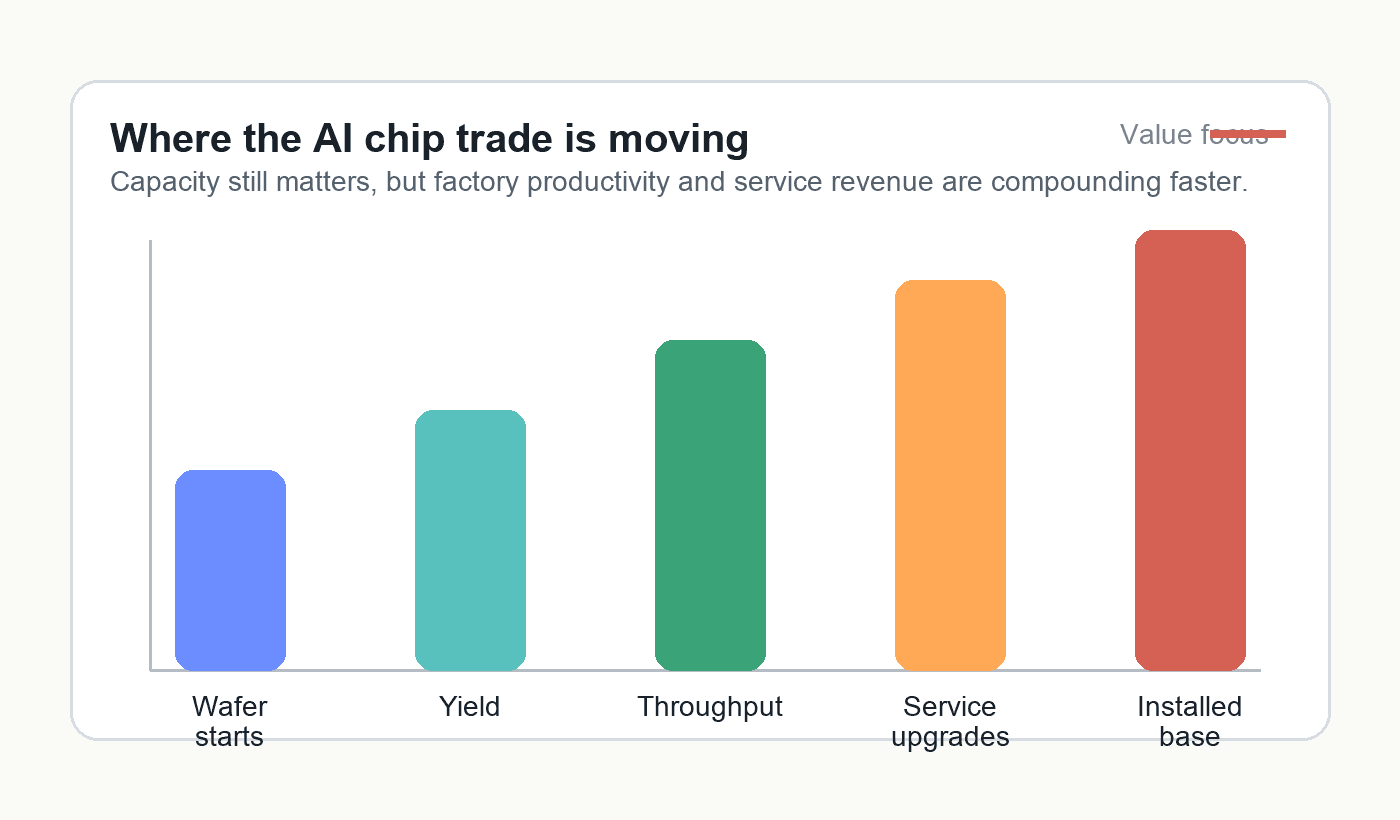
Investors often assume semiconductor equipment is a classic cyclical hardware business: order booms, then order busts. But AI is pushing these companies toward something more durable. If customers are desperate to raise yield, reduce defects, and lift throughput on expensive advanced lines, then the installed base starts to behave less like old hardware and more like a recurring optimization platform.
Lam's comments make that shift unusually explicit. Chief executive Tim Archer told Reuters the company wants to equip tools with more sensors that generate data for AI systems to identify problems and inefficiencies earlier. That is not a cosmetic software layer. On advanced nodes, a small improvement in yield or uptime can be worth a lot because the wafers being processed are tied to premium AI chips and high-bandwidth memory that are already supply-constrained.
ASML's numbers support the same thesis from another angle. The company raised its 2026 sales outlook to a range of 36 billion to 40 billion euros and said customers had increased expected short- and medium-term demand. Just as important, ASML highlighted demand not only for new systems but also for performance upgrades to the installed base. When the bottleneck is severe enough, customers do not just buy another tool. They pay to make the current tool better.
This is the hidden business-model consequence of the AI boom. The winners upstream are not only the companies shipping the biggest boxes. They are the ones turning operational pain inside the fab into a long tail of service, data, and upgrade revenue. That can smooth cyclicality, deepen customer dependence, and make the AI capex wave harder to unwind than a normal semiconductor surge.
There is also a strategic angle for U.S. investors. Lam said it plans expanded operations in Arizona and California to support customers including TSMC. That suggests proximity itself is becoming a competitive asset. If fabs need faster support, tighter data loops, and more frequent upgrades, then regional service capacity matters more. The AI supply chain is not just global manufacturing anymore. It is local response time.
None of this means equipment stocks are risk-free. Export controls, customer concentration, and eventual overspending are still real hazards. But the market may still be underestimating how much value is shifting from one-time tool sales into ongoing factory performance. The casual version of the AI semiconductor story is that everyone is racing to build more chips. The sharper version is that the most valuable companies may be the ones selling better output from every wafer already in the line.