Banks Are Turning AI Into White-Collar Operating Leverage

Bank investors keep talking about artificial intelligence as if the payoff will arrive through shiny new products. The more immediate change is less glamorous and probably more important: AI is starting to reopen operating leverage inside large financial institutions.
That shift came into focus this week from two directions. On May 19, Standard Chartered said it aims to cut more than 15% of corporate function roles by 2030 while using automation, advanced analytics, and artificial intelligence to improve productivity. Two days later, Reuters reported that JPMorgan is rolling out AI tools across its investment banking business globally to help bankers prepare materials faster and engage more clients more efficiently.
The thing casual readers are missing is that the first durable AI profit pool in banking may not come from selling AI at all. It may come from turning white-collar bank work into a lower-cost, higher-throughput production system. In finance, that matters because a lot of the most expensive work is repetitive, document-heavy, regulated, and already attached to measurable workflows.
Standard Chartered’s announcement made the financial logic unusually explicit. The bank tied workforce reduction to a plan to lift return on tangible equity and improve its cost-to-income ratio. That is a reminder that, for banks, AI is not being budgeted like a moonshot. It is being budgeted like efficiency capex with a target margin outcome.
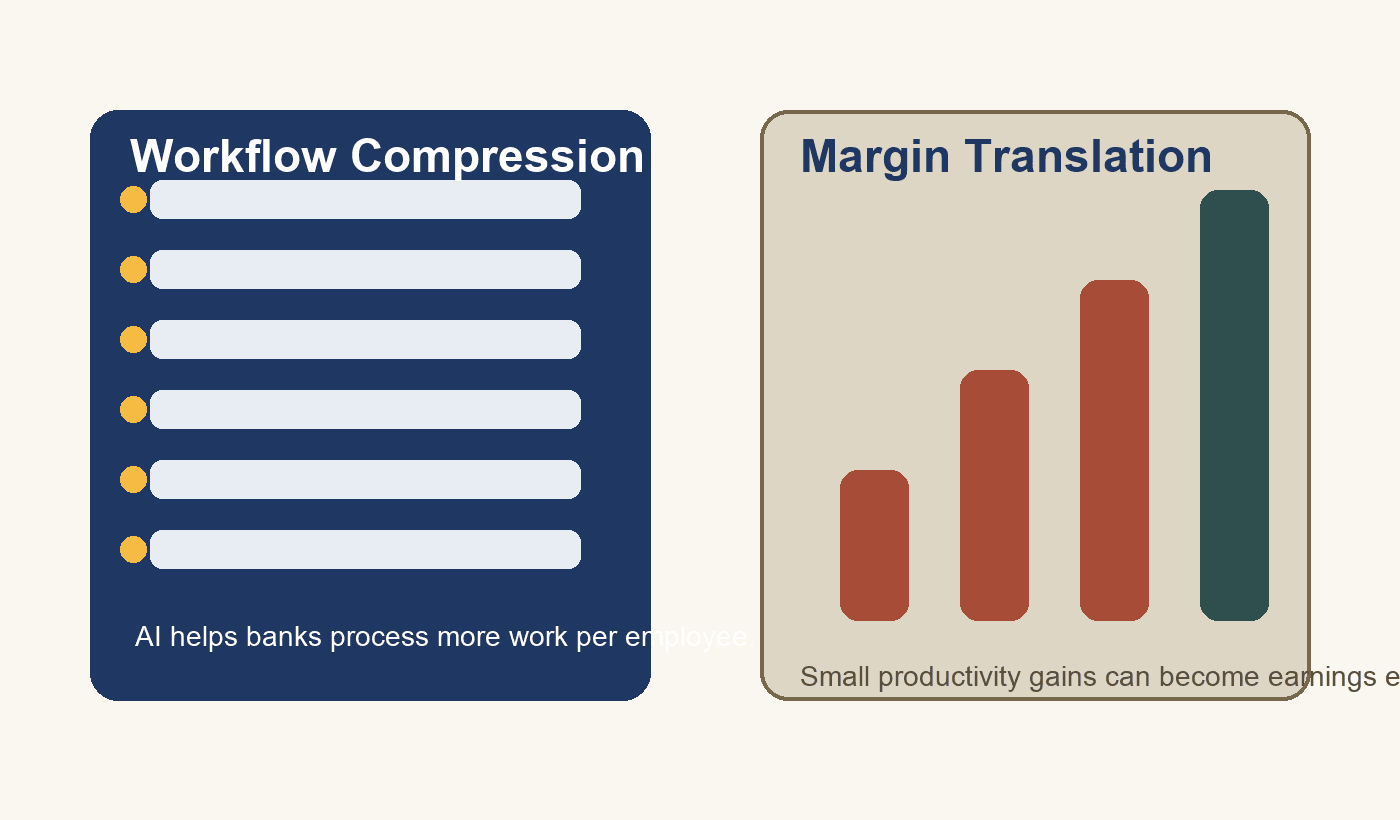
JPMorgan’s comments point to the same destination from a different starting point. The bank is not framing AI only as a back-office cut. It is using the tools in investment banking, where speed, synthesis, internal knowledge, and client coverage all matter. In its February company update, JPMorgan executives said AI-enabled controls work had already expanded from a 200-person use case to 3,000 employees, with several thousand more people likely to benefit. That matters because it shows large incumbents are not waiting for a single killer app. They are spreading narrow efficiency gains across huge employee bases.
This is why the banking AI story is more investable than many enterprise AI narratives. A lot of software companies are still arguing about whether AI will defend pricing or compress it. Banks do not need to win that debate first. If AI helps a banker handle more accounts, helps compliance teams review documents faster, or reduces error-prone controls work, the benefit can show up in expense ratios before it ever shows up in a new revenue line.
It also helps explain why banks sound more concrete than many other white-collar employers. Their workflows already revolve around approvals, documentation, escalation paths, and audit trails. That makes it easier to measure whether AI is actually reducing hours, speeding cycle times, or lowering error rates instead of merely producing an impressive demo.
That also means the early winners may be the institutions many people assumed would be most vulnerable. Big banks have the ingredients that matter for this phase: expensive labor, massive internal data, strict control environments, and enough workflow volume for small productivity gains to compound. A startup can build a clever model, but a global bank can turn a 5% or 10% efficiency improvement into a real earnings event.
There is still execution risk. Banks sit on legacy systems, AI raises cyber and model-risk concerns, and management teams will overstate productivity before it fully reaches the income statement. Even so, the direction is becoming harder to dismiss. Standard Chartered is cutting roles against explicit profitability targets, while JPMorgan is widening deployment inside revenue-generating teams.
The sharper takeaway is that banking may become one of the first major white-collar industries where AI is felt less as a product revolution and more as a cost-structure reset. If that is right, investors should stop looking only for AI revenue stories in finance. The more powerful signal may be which institutions can convert AI into lower unit labor costs without losing control, trust, or client reach.