AI Isn’t Killing Enterprise Software. It’s Repricing the Stack.

Enterprise software stocks are starting to trade like the market has finally figured out what AI threatens and what it protects. The old broad-brush fear was that generative AI would flatten the whole sector by turning software into a commodity. This week’s price action suggests investors are getting more selective than that.
Reuters reported on May 22 that Workday shares jumped after its quarterly results eased fears that AI-native challengers would quickly break demand for traditional back-office software. Three days earlier, Reuters also noted a rebound across software names, but with an important split inside the group: analysts were getting more constructive on deeply embedded workflow platforms like ServiceNow while warning that more traditional seat-based models such as Salesforce faced a more structural threat.
The thing casual readers are missing is that AI is not just disrupting software. It is repricing the stack. Systems that merely display information are getting cheaper. Systems that hold the record, govern permissions, route approvals, and trigger actions across a company are getting more valuable.
That is why ServiceNow matters beyond its own earnings. In its April results, the company said subscription revenue rose 22% to $3.67 billion, current remaining performance obligations climbed 22.5% to $12.64 billion, and customers spending more than $1 million annually on its Now Assist products grew more than 130% year over year. Those are not the numbers of a company being disintermediated by chatbots. They are the numbers of a company convincing customers that AI without workflow control is not enterprise software. It is a demo.
The company made the strategy even clearer in early April when it said AI, data connectivity, workflow execution, security, and governance would be built into every offering by default. That move looks less like product packaging and more like market positioning. ServiceNow is effectively arguing that intelligence will be abundant, but trusted execution inside a live enterprise environment will stay scarce.
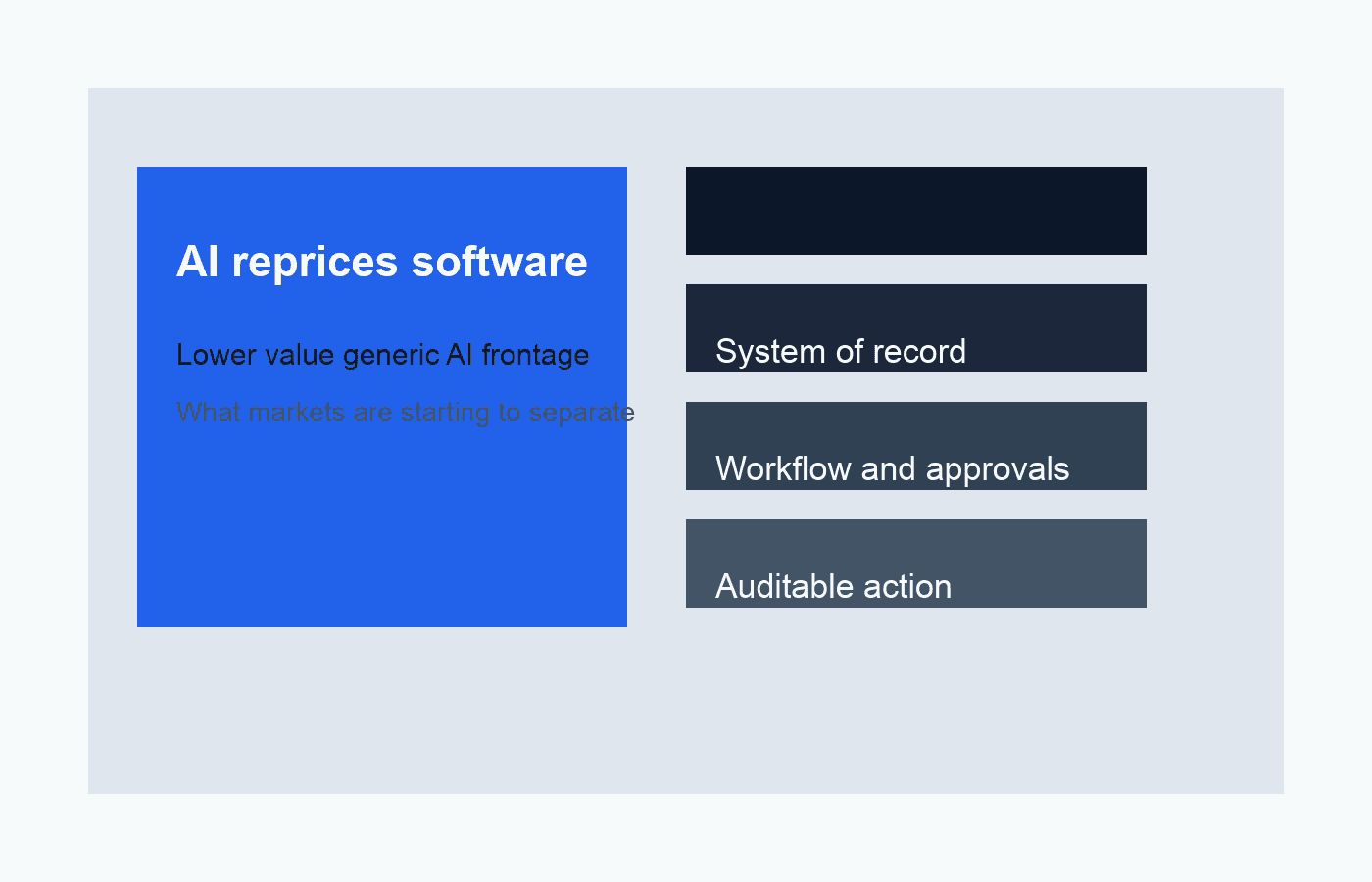
That framing helps explain why Workday got relief, too. Reuters said investors treated its quarter as evidence that a system-of-record vendor with 80 million users and strong retention is harder to dislodge than the market feared. The point is not that Workday is immune to AI. It is that AI has to plug into payroll, finance, identity, approvals, and compliance before it can replace anything meaningful. The software that already sits on those rails has more leverage than the market gave it credit for.
This also explains why the pressure is rising on vendors whose value proposition is closer to interface, access, or per-seat productivity. If an AI layer can answer the question, draft the content, and complete the basic task, the standalone software seat starts looking expensive unless it owns a deeper operational choke point. Wall Street is beginning to distinguish between software that stores business truth and software that simply surrounds it.
That distinction matters because it changes where enterprise AI budgets may go next. The first leg of the AI trade was about chips, cloud, and data-center power. The next leg inside software may be less about who has the flashiest assistant and more about who can turn a model output into an auditable action. In other words, the winners may look less like app vendors and more like traffic controllers for the enterprise.
If that view is right, the software trade is not coming back as one group. It is breaking in two. Companies that own workflow, permissions, and business context could end up with stronger pricing power in an AI-heavy world, even as simpler SaaS categories get pushed toward compression. AI is not killing enterprise software. It is exposing which parts were infrastructure all along.