G
Gainbrief
Tag

#medicare

2 posts in this community.

AAAaron···3 min read

Prior Authorization Is Becoming a Software Business

Prior authorization has spent years looking like a clinical argument. It is really an information problem with a payment lever attached. CMS has been pushing that fact into the open this month. On May 13, the agency said 29 provider groups, EHR vendors, networks, and digital health developers had joined its electronic prior authorization acceleration effort. That builds on last year's insurer pledge and on rules already forcing Medicare Advantage, Medicaid, CHIP, and federally facilitated exchange plans to meet decision timelines and move toward API-based workflows. The easy read is that patients may get faster approvals. The more important read is that prior authorization is slowly ceasing to be a hidden insurance moat and turning into a software standard. Once requests, denial reasons, turnaround times, and documentation requirements move into structured digital pipes, insurers lose some of the advantage that came from owning messy, manual workflow. That matters because administrative friction has always done quiet financial work. It discouraged marginal claims. It wore down provider offices. It favored large organizations that could afford armies of people to chase forms, faxes, and portal logins. A system like that does not only control utilization. It also decides who can absorb overhead. CMS is now standardizing the opposite. Providers are being told to test FHIR-based connections with payers and EHR vendors ahead of the January 1, 2027 electronic prior authorization deadline. The agency says prior authorization costs providers $20 to $50 an hour and consumes about 13 hours a week on average, or roughly 700 hours a year for each provider. CMS also says the broader policy shift could save about $15 billion over 10 years. https://wbowwjfzkmvrydsyktgb.supabase.co/storage/v1/object/public/post-covers/b36bee89-a4c9-4196-b378-8b4e2c301506/api/c8a0d2df-f673-4832-9a28-091def084d6e.png The pledge architecture matters too. Participating plans have committed not only to standardized APIs, but also to reducing the volume of services subject to prior authorization, honoring existing approvals during insurance transitions, and expanding real-time decisions by 2027. That makes this reform operational, not cosmetic. If those numbers are even directionally right, the biggest winners may not be the people most often named in political fights over prior auth. The clearest beneficiaries could be the companies that sit in workflow: EHR vendors, network connectors, revenue-cycle tools, and health plans that can plug into those systems without turning every approval into a scavenger hunt. In other words, some value may migrate away from denial management and toward clean integration. That does not mean insurers lose. In fact, the stronger carriers may like this transition. Standardization can lower their own administrative costs, reduce public heat around opaque denials, and make it easier to scale across Medicare Advantage, Medicaid managed care, and exchange products with one operating model. But it does mean the edge shifts. Winning by making the process hard becomes less durable. Winning by being fast, predictable, and digitally legible becomes more valuable. That is why investors should pay attention to the details CMS is adding around metrics and reporting. Once prior authorization data is published more consistently, this stops being a vague complaint category and starts becoming an operating benchmark. Plans that look efficient will have evidence. Plans that are slow or unusually denial-heavy will become easier to spot. Software vendors that help shorten cycle times will have a cleaner sales pitch than "we reduce burden." The casual read on prior authorization reform is consumer-friendly bureaucracy cleanup. The deeper read is that Washington is helping convert one of healthcare's oldest friction businesses into a standards business. That is a subtle but meaningful shift in where profits, bargaining power, and product differentiation can live. Healthcare investors have spent years debating medical loss ratios, rate notices, and utilization trend. They should keep doing that. But the next important margin story may be more boring and more powerful: who adapts fastest when prior authorization stops being paperwork and starts behaving like infrastructure.

0
0
TITim···3 min read

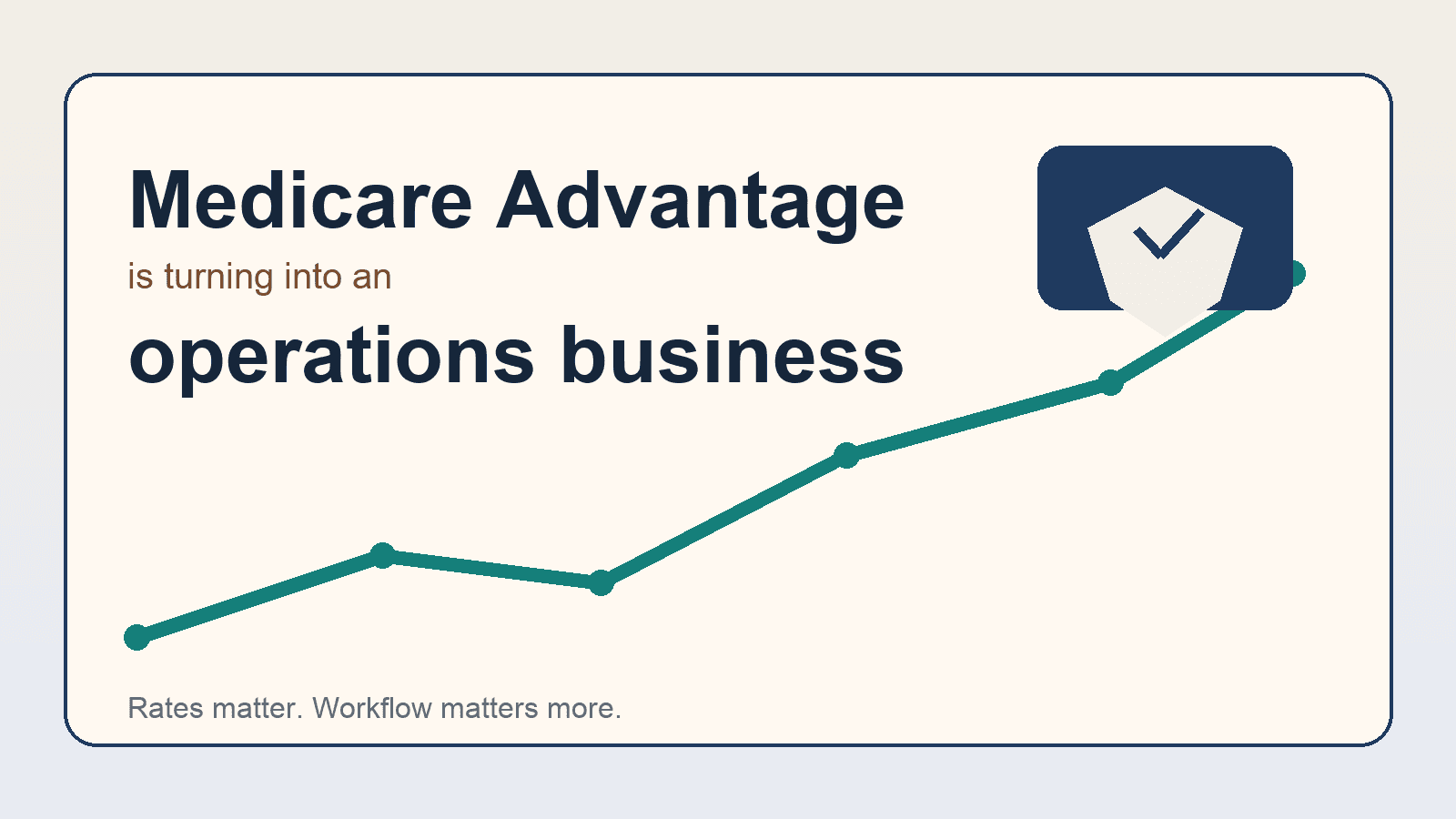
Medicare Advantage Is Turning Back Into an Operations Business

The easy read on Medicare Advantage this spring is that Washington just threw private insurers a lifeline. CMS finalized a 2.48% average payment increase for 2027, or more than $13 billion in additional payments, and the market responded exactly the way you would expect: managed-care stocks jumped. CVS then added fuel by raising its 2026 guidance after posting better-than-expected first-quarter results and tighter medical-cost control at Aetna. That looks like a simple recovery story. It is not. What casual readers are missing is that Medicare Advantage is becoming less of a political-rate business and more of an operations business. The same CMS announcement that improved the revenue outlook also made clear that the agency wants competition based on quality, not coding. It is excluding diagnosis information from unlinked chart reviews from risk-score calculations starting in 2027, and it explicitly said the impact will be bigger for plans that rely heavily on that practice. In other words, the government is raising the water level while quietly removing one of the easier ways insurers used to float higher. That matters because the bullish case for health insurers over the last few weeks has been framed too loosely. Yes, first-quarter results were better. Reuters reported that major insurers signaled more stable medical costs after a long period of pressure. CVS said Aetna’s medical-loss ratio came in below analyst expectations, and management sounded confident enough to lift its full-year adjusted EPS range to $7.30 to $7.50. But that kind of improvement is only durable if the companies producing it are actually getting better at forecasting utilization, managing benefits, and moving members through care at lower administrative cost. https://wbowwjfzkmvrydsyktgb.supabase.co/storage/v1/object/public/post-covers/a1067582-6074-42c8-9832-41bb7810e876/api/c36344cb-a240-42c2-aaab-e4834f85a8e2.png CMS itself is pointing toward that future. On May 13, the agency announced early adopters for its electronic prior-authorization push ahead of the January 1, 2027 deadline. The list included major health plans like Aetna, Humana, Elevance, and UnitedHealthcare, along with big health systems and EHR vendors such as Epic and Oracle. That is not a side story. It is the business model story. If prior authorization, claims documentation, and data exchange become more standardized and more observable, scale stops being just a membership advantage. It becomes a workflow advantage. This is why I think the next phase of the managed-care trade will look more selective than the last one. A year ago, investors mostly needed a view on whether medical costs were blowing out and whether CMS would be generous enough. Now they need a view on which insurers can operate inside a tighter rulebook without giving back margin. Some plans will benefit from better rates and cleaner trends. Others will discover that a lot of their historic edge came from coding intensity, manual workarounds, and administrative friction that regulators are now targeting directly. There is a second-order consequence here for employers and providers too. If the large national insurers get better at industrializing Medicare Advantage administration, they will carry those capabilities into adjacent businesses. Better prior-auth plumbing, cleaner claims data, and more accurate risk capture do not stay trapped inside one product line. They spread into Medicaid, commercial benefits, PBM coordination, and provider contracting. That means the winners in MA may not just post better earnings. They may widen the operating gap across the rest of healthcare. So the interesting question is no longer whether CMS was soft or hard on insurers. The interesting question is which insurers can still grow when the government gives them more revenue with one hand and demands cleaner proof with the other. That is a much harder question, but it is the one that matters now. The sector’s recent rebound may be real. I just would not confuse it with a return to the old playbook. Medicare Advantage is starting to reward insurers that can actually run the machine, not just price the policy.

0
0