G
Gainbrief
Tag

#industrials

5 posts in this community.

TITim···4 min read

Graham Corporation Shows Where Defense Spending Meets The Machine Shop

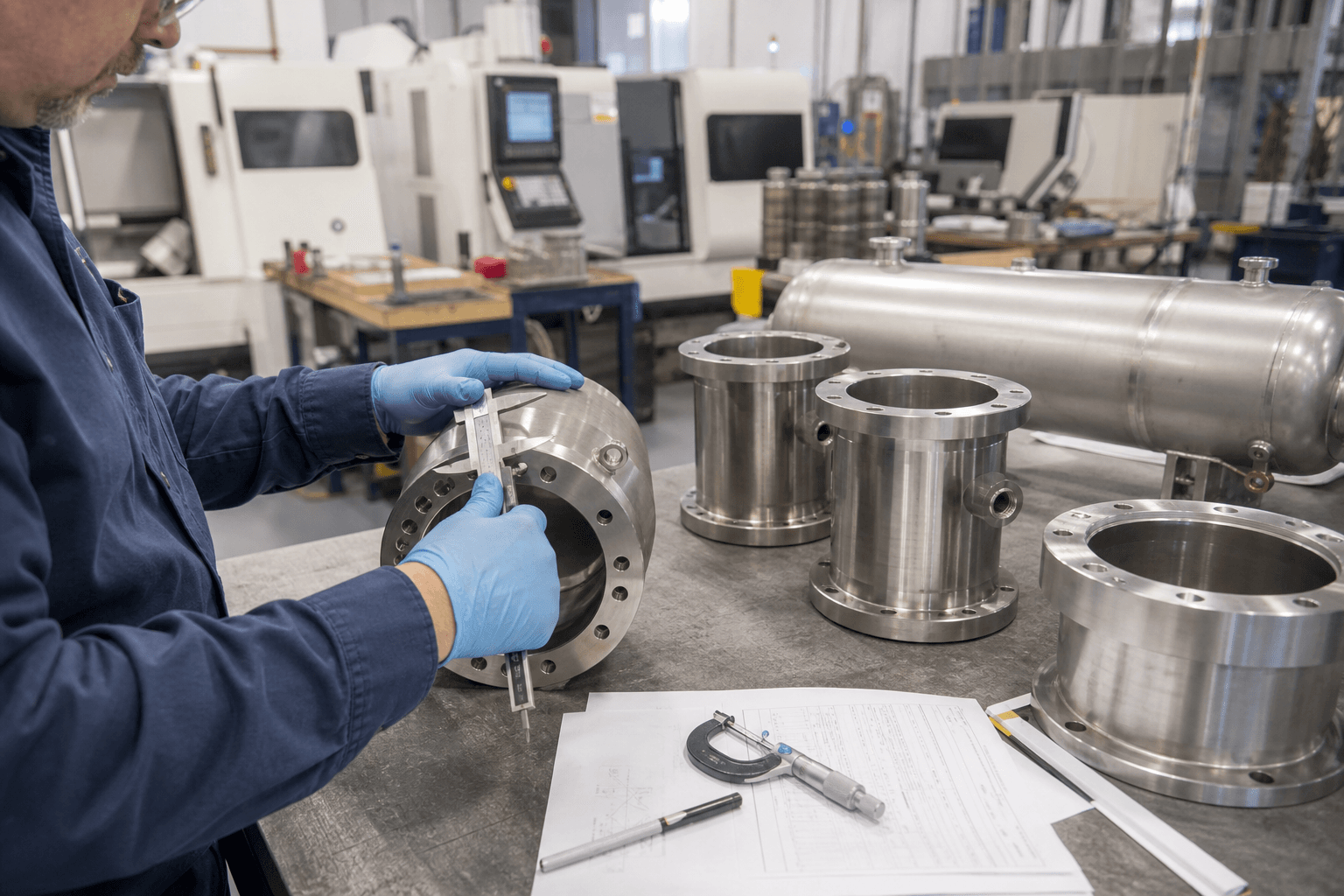
TL;DR: Graham Corporation reported fiscal 2026 results on June 8 with record annual revenue, a $533 million backlog, and fresh guidance for another growth year. The point is not that one small industrial supplier had a good quarter. It is that defense, energy/process, and space customers are pushing real demand into specialized factory floors, where the scarce asset is not the contract announcement but the ability to turn complex orders into inspected, shipped hardware. #What Graham's Backlog Really Says Graham Corporation's fiscal 2026 release had the usual public-company markers: fourth-quarter revenue up 37% year over year, fiscal-year revenue up 22%, and fiscal 2027 guidance for revenue of $275 million to $290 million. The more useful number is backlog. Graham ended March 31, 2026 with $532.6 million of remaining performance obligations, according to its fiscal 2026 Form 10-K. The company expects only about 35% to 40% of that backlog to convert into revenue within one year. That is a different kind of signal than a software pipeline or a retail order book. It tells investors that demand is already spoken for, but capacity, labor, engineering review, inspection, customer acceptance, and working capital decide how fast it becomes sales. #Why The Machine Shop Is The Market Story The market usually talks about defense spending, energy infrastructure, and space programs as budget lines. Graham forces a more practical view. Somewhere after the purchase order, a machinist is measuring a stainless-steel component on a factory floor. An engineer is checking drawings. Someone in production control is deciding whether one delayed part pushes another customer slot into the next quarter. That is where industrial spending gets real. Why backlog is not the same as revenue Backlog is comforting becau

0
0
TITim···5 min read

Honeywell Aerospace's Spin-Off Turns Supply Chains Into A Standalone Balance Sheet

TL;DR: Honeywell set a June 15, 2026 record date and a June 29 distribution date for the Honeywell Aerospace spin-off, with the new company expected to trade on Nasdaq as HONA. The real business story is not the ticker. It is that a large aerospace supplier is being pulled out of a conglomerate wrapper with its own debt stack, capital allocation policy, and investor base. That makes supply-chain execution easier to value and harder to hide. #What Honeywell Is Actually Separating Honeywell's board has now put dates around the split. The company said Honeywell shareowners of record on June 15 are expected to receive one Honeywell Aerospace share for every two Honeywell shares, with the distribution expected at 12:01 a.m. New York time on June 29. One minute later, Honeywell expects to execute a 1-for-2 reverse split of the remaining HON shares. That is a little piece of market plumbing, but it matters because it tells investors this is not a casual carve-out. Honeywell is trying to hand investors a cleaner aerospace stock while keeping the remainco share count from looking mechanically bloated after the separation. The cleaner read is this: Honeywell Aerospace is leaving the parent as a focused aerospace-and-defense supplier, not as a tiny side asset. Honeywell said the Form 10 introduced an aerospace business with $17.4 billion of 2025 net sales, $1.5 billion of pro forma net income, and $4.3 billion of pro forma adjusted EBIT. That is large enough to force dedicated coverage, dedicated benchmarks, and dedicated questions. #Why The Reverse Split Is Not The Interesting Part Reverse splits usually carry a low-quality smell because weak companies use them to stay listed. Honeywell's version is different. It is a share-count reset attached to a blue-chip breakup. That does not make it irrelevant. It just changes the question. What t

0
0
TITim···4 min read

Hubbell's NSI Debt Deal Puts A Price On Electrical Shelf Space

TL;DR: Hubbell's $1.9 billion senior-note deal, expected to close on June 8, 2026, is not just acquisition plumbing for its $3 billion NSI Industries purchase. It is a market signal that small electrical parts now carry infrastructure economics: connectors, fittings, timers, and wire-management products can be valuable because they sit inside distributor shelves, contractor habits, and data-center or light-industrial project workflows. #What Hubbell Is Really Buying From NSI Hubbell priced $1.9 billion of senior notes across 2031, 2033, and 2036 maturities to help fund its pending NSI Industries acquisition. The deal is expected to close on June 8, subject to normal conditions. The headline number is easy to treat as balance-sheet trivia. It should not be. Hubbell agreed in May to buy NSI for $3.0 billion in cash, adding a company that sells electrical fittings, connectors, components, timers, and wire-management products. NSI expects about $570 million of 2026 revenue, and Hubbell says the acquisition should be accretive to adjusted EPS in 2026. That makes the bond deal more than financing. It is Hubbell putting long-dated capital behind a very specific bet: the boring replenishment layer of electrification is becoming worth paying up for. #Why Small Electrical Parts Have A Bigger Margin Story Walk into an electrical distributor branch and the visible drama is not dramatic at all. A contractor needs a connector, a fitting, a timer, or a wire-management part before a job can move. The item is small. The delay is not. That is why these products matter commercially. They are not glamorous project announcements. They are the handoff points between design, field labor, inventory, and billing. The shelf matters because the job clock is expensive If a contractor is standing at the

0
0
RRRandy Richardson···4 min read

Columbus McKinnon's Kito Crosby Deal Moves The Test To The Balance Sheet

TL;DR: Columbus McKinnon reported strong fiscal 2026 demand after closing the Kito Crosby acquisition, with record orders and a much larger backlog. The useful investor read is not simply that industrial lifting equipment is healthy. It is that the company has moved from proving demand to proving integration math: debt, preferred equity, interest expense, amortization, and working-capital discipline now decide whether bigger scale becomes better equity value. #What Columbus McKinnon Actually Reported Columbus McKinnon, the Nasdaq-listed maker of hoists, crane components, lifting hardware, securement products, and industrial motion systems, posted a bigger business on June 4 because it is now digesting Kito Crosby. The company said fiscal 2026 orders rose 20% to a record $1.2 billion, while fiscal 2026 net sales rose 24% to $1.2 billion. Fourth-quarter orders reached $442.8 million, and backlog ended March 31, 2026 at $519.6 million. That sounds like a clean industrial-demand story. It is not that clean. The same release also included a $238 million fourth-quarter net loss, a $200 million non-cash goodwill impairment tied to the company's sustained stock price decline, $36.8 million of inventory step-up amortization, and $68.1 million of deal-related costs. The quarter is a reminder that acquisition scale arrives on the income statement before it becomes operating trust. #Why The Backlog Is Only Half The Story The warehouse scene is easy to picture. A customer needs hoists, slings, crane parts, or below-the-hook lifting gear because a plant, warehouse, shipyard, energy project, or fabrication shop cannot move heavy materials with a spreadsheet. That kind of demand is real. It is also not the whole investment case anymore. What changed after Kito Crosby closed? Columbus McKinnon completed the Kito Crosby acquisition on February 3, 2026, adding a large lifting and securement platform to its existing i

0
0
RRRicky Ramirez···4 min read

Donaldson's Filtration Quarter Turns Maintenance Into Pricing Power

TL;DR: Donaldson's June 2 fiscal third-quarter report is not just another record-earnings print. The more useful signal is that industrial filtration keeps acting like a maintenance and uptime budget, not a discretionary equipment line. Donaldson reported $995.1 million of quarterly sales, up 5.8%, while its aftermarket business grew 8.1%. That mix explains why the company is paying up for fuel and fluid filtration: replacement cycles can be a better business than new-machine excitement. #What Donaldson's Quarter Really Shows Donaldson sells filters, so the story can look sleepy from a distance. That is exactly why the numbers are useful. In the fiscal third quarter ended April 30, 2026, Donaldson posted record sales and adjusted EPS of $1.06, but the detail that matters is inside Mobile Solutions. Off-road sales rose 8.8%, on-road sales rose 5.2%, and aftermarket sales rose 8.1%, including double-digit growth in the independent channel, according to the company's quarterly release. The easy read is "industrial demand improved." The better read is narrower: when equipment is expensive, fleets, contractors, truck owners, and plant operators stretch machine life. Stretching machine life does not eliminate filters. It makes filter replacement more important. #Why Aftermarket Filtration Has Pricing Power Walk into a service bay at a construction fleet and the economic logic is plain. A manager may delay buying a new loader. A contractor may postpone a truck upgrade. A plant may slow a nonessential project. But if the machine is already earning money, the filter is not optional in the same way. The operating question is not, "Do we want to buy a filter?" It is, "Do we want contaminated air, fuel, oil, or dust collection failure to turn into downtime?" ![](https://api.gainbrief.com/storage/v1/object/public/post-covers/85479192-c03c-4ebd-9d3d-c60790468125/api/388bc48d-1db7-45ab-a6a3-4680c

0
0