Medicare Is Putting a Scarcity Premium on Home Health

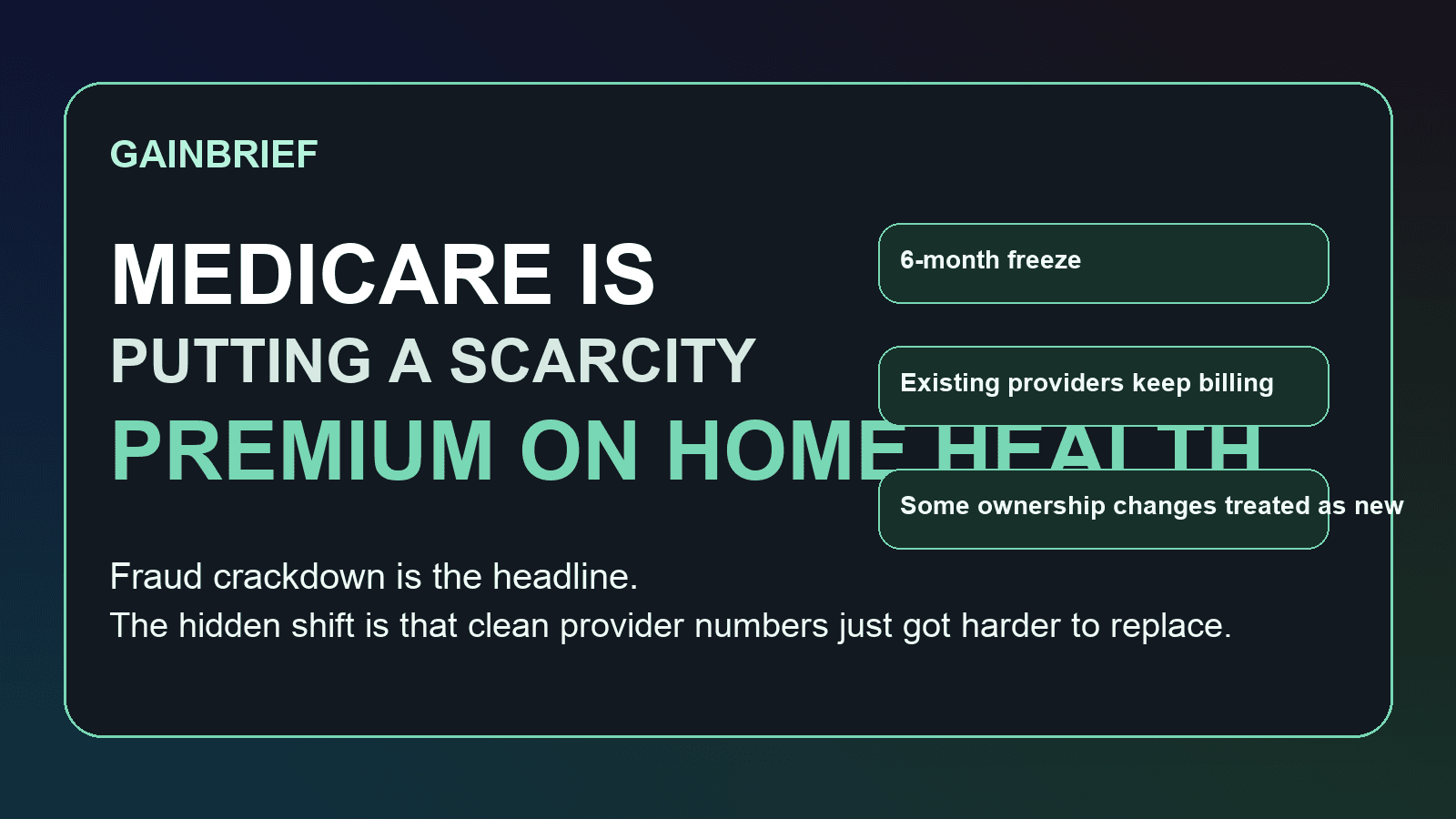
The Trump administration's new Medicare freeze on home health and hospice enrollments looks like a fraud story. It is also a balance-sheet story.
On May 13, CMS imposed a six-month nationwide moratorium on new Medicare enrollment for home health agencies and hospices. Reuters reported the administration framed the move as a response to widespread fraud, and the official CMS notice made clear that existing providers can keep operating while new applicants are shut out.
The detail most casual readers are missing is that CMS did not just slow new entrants. It made existing Medicare-ready capacity scarcer. The agency's own moratorium page says the freeze also applies to certain changes in majority ownership, and its FAQ explains that home health or hospice providers that undergo a majority ownership change within 36 months can be treated as brand-new providers and become subject to the freeze. In plain English, this policy can make a clean, already-enrolled provider number more valuable overnight.
That matters because home health and hospice are not tiny corners of American healthcare. Reuters, citing MedPAC, said 2.7 million Medicare patients received home healthcare in 2024 at a cost of $16 billion, while 1.8 million beneficiaries received hospice care at a cost of $28.3 billion. When Washington temporarily closes the front door to new supply in markets that large, it does more than punish fraud. It shifts bargaining power toward incumbents that already have compliant operations, staff, and billing relationships.
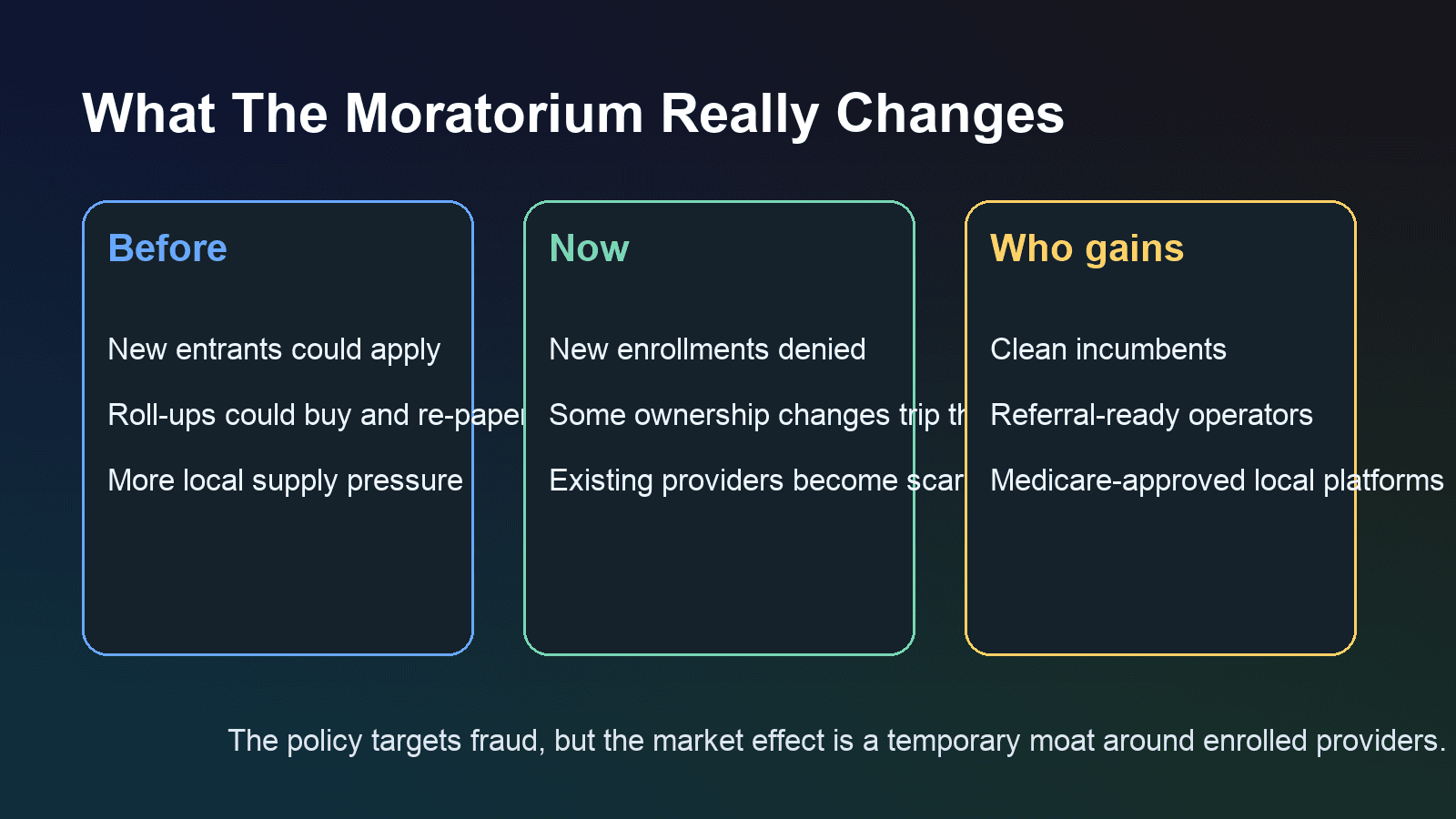
This is where the policy becomes a business-model event. In many industries, anti-fraud crackdowns reduce demand. Here, they may increase the strategic value of the survivors. A regional operator with a clean compliance record is no longer just selling patient care capacity. It is selling scarce access to a federal payment stream that new competitors cannot easily replicate during the moratorium. That can support higher acquisition multiples, stronger referral leverage, and more disciplined pricing in markets where too many questionable entrants were previously chasing reimbursement.
The effect could be strongest in fragmented local markets. CMS said the pause is meant to stop bad actors from shifting across state lines, and it highlighted prior oversight actions in places such as California, Georgia, Ohio, and Texas. But legitimate demand for in-home care does not pause with the enrollment system. Patients still age. Hospitals still want lower-cost discharge options. Families still need end-of-life care. If new supply is constrained while demand keeps moving, clean incumbents can become the default counterparties for referral networks and managed-care partners.
There is a tradeoff, and it is real. Industry groups told Reuters they worried an overly broad freeze could make it harder for patients and physicians to find care. CMS says current providers can continue to participate in Medicare and submit claims, but a six-month national freeze is still a blunt instrument. In markets already short on capacity, the line between fraud prevention and supply restriction can get thin fast.
That is why investors should treat this as more than another healthcare enforcement headline. The administration may be trying to stop abuse, but the economic side effect is to create a temporary moat around enrolled providers that can pass compliance scrutiny. If the moratorium is extended, that moat gets wider. If it is lifted quickly, the scarcity premium may fade, but not before it reshapes transaction timing and local competition.
The biggest losers may not be the obvious fraudsters. They are the would-be entrants, turnaround buyers, and smaller consolidators that depended on fresh enrollment or quick ownership changes to build scale. The winners are the operators that already own one of the few assets Washington has made harder to reproduce: a clean path into Medicare reimbursement.