I write about markets, business, investing, and the small signals behind big financial moves.

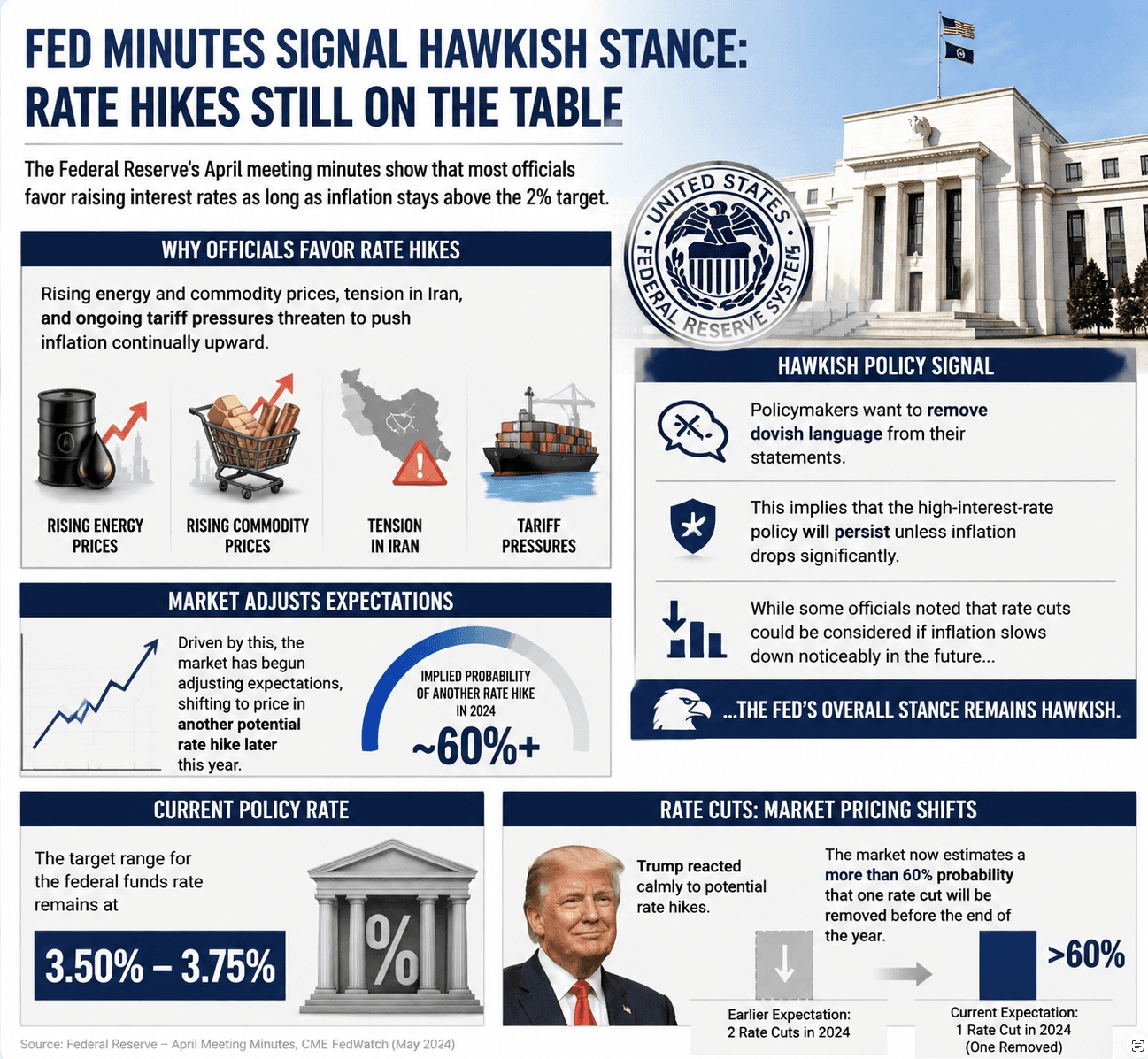
The Federal Reserve's April meeting minutes show that most officials favor raising interest rates as long as inflation stays above the 2% target. This preference stems mainly from rising energy and commodity prices, alongside tension in Iran and ongoing tariff pressures, which together threaten to push inflation continually upward. According to the minutes, policymakers want to remove dovish language from their statements. This implies that the high-interest-rate policy will persist unless inflation drops significantly. While some officials mentioned that rate cuts could be considered if inflation slows down noticeably in the future, the Fed's overall stance remains hawkish. Driven by this, the market has begun adjusting expectations, shifting to price in another potential rate hike later this year. Currently, the target range for the federal funds rate remains at 3.5% to 3.75%. Although Trump reacted calmly to potential rate hikes, the market now estimates a more than 60% probability that one rate cut will be removed before the end of the year.
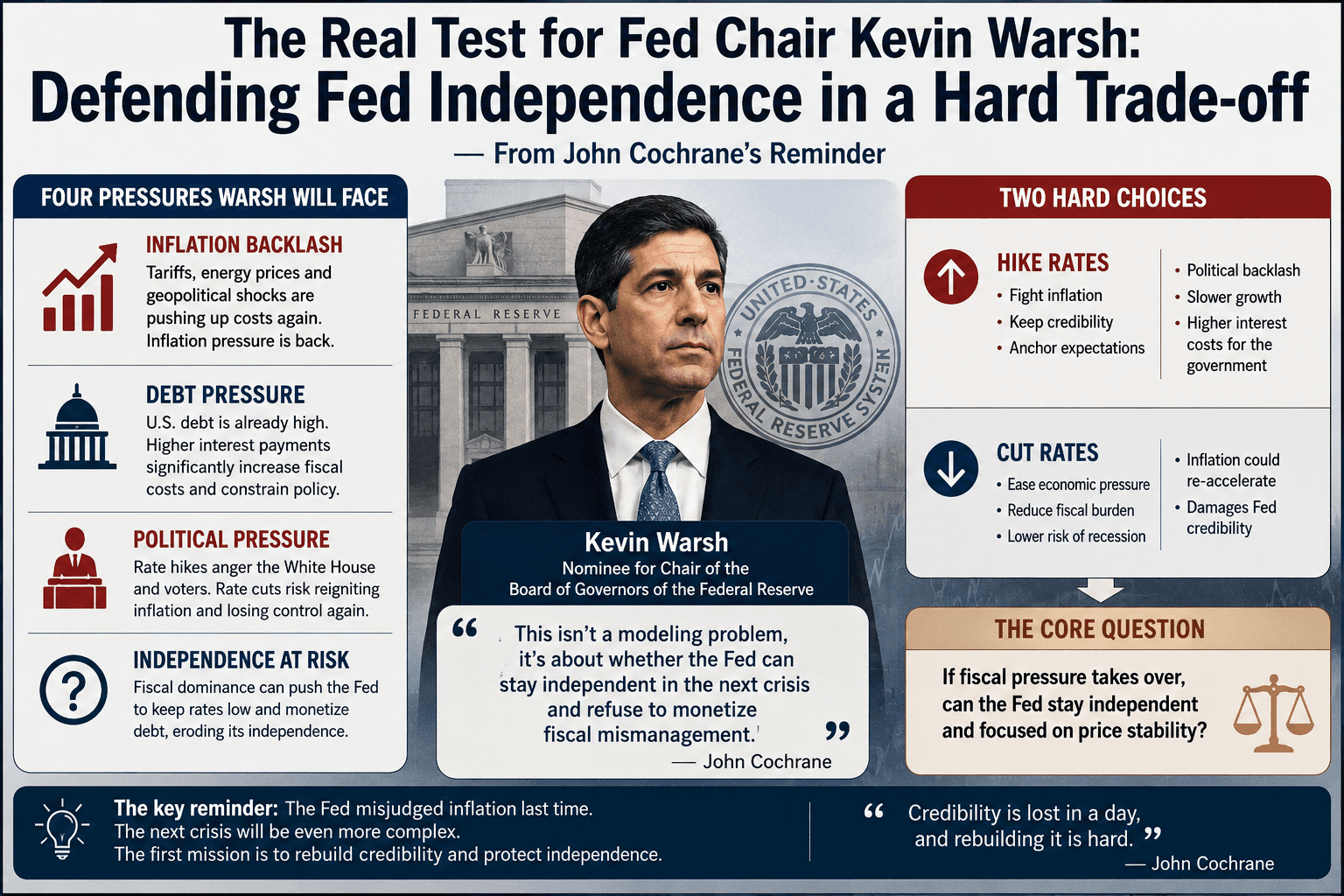
The newly appointed Federal Reserve Chair, Kevin Warsh, steps into a formidable set of challenges. Earlier this year, the prevailing debate centered on the pace of interest rate cuts. Yet, a resurgence in inflation driven by tariffs and geopolitical conflicts has fundamentally upended those expectations. The current economic landscape looks starkly reminiscent of the 1979 stagflation crisis, leaving him caught in a tightening vice. He faces an unenviable choice. On one path, he can raise interest rates to combat inflation, a move that would guarantee severe friction with the White House and risk tipping the economy into a slowdown. On the alternative path, he could adopt a wait-and-see approach, hoping prices stabilize on their own. However, this inertia would offer no relief to a public already deeply frustrated by a punishingly high cost of living. Looking further ahead, unconstrained fiscal deficits loom large. This structural reality threatens to subject the Federal Reserve to intense political co-optation, potentially forcing the central bank to monetize runaway government debt. Consequently, the traditional playbook of large-scale asset purchases to stabilize markets may prove entirely ineffective in the next crisis. This predicament cannot be resolved through clever communication strategies or blind reliance on artificial intelligence to boost productivity. The Federal Reserve must fundamentally re-examine its past role in accommodating massive fiscal expansion. Failure to do so risks a severe loss of institutional credibility, leaving global markets to deliver a harsh verdict.
Andrew Dai’s 14 years at Google basically trace the tech giant’s entire AI journey through the deep learning era. He was a key member of core research teams at both Google Brain and DeepMind. His work spanned early sequence learning that inspired GPT, text generation and adversarial training, all the way to MoE architecture, PaLM, Flan, Gemini, multimodal technology and long-context models. He co-authored papers with top Google tech elites including Quoc Le, Ian Goodfellow, Liam Fedus and Jeff Dean. After the successful launch of Gemini 3.0, Andrew decided to quit his job. He spotted a path that big tech firms dare not take — neither pure language models nor world models, but an integration of linguistic and visual reasoning. His new startup Elorian AI secured 55 million US dollars in funding last April, with Jeff Dean joining in as a private investor。
by 硅谷101
Will the Fed cut interest rates? The answer is crystal clear now. Don’t expect any rate cuts in 2026; we’ll be lucky if they don’t hike rates again. Ignore all the market speculations, the hard data speaks for itself. America’s April CPI hit a 3-year high of 3.8% year-on-year, with a 0.6% month-on-month rise, and core inflation stood at 2.8%, all exceeding forecasts. With inflation still running hot, how could the Fed slash rates? That would only make things worse and undo all its past efforts to curb inflation.