The AI Boom Is Minting a New Class of Power Brokers

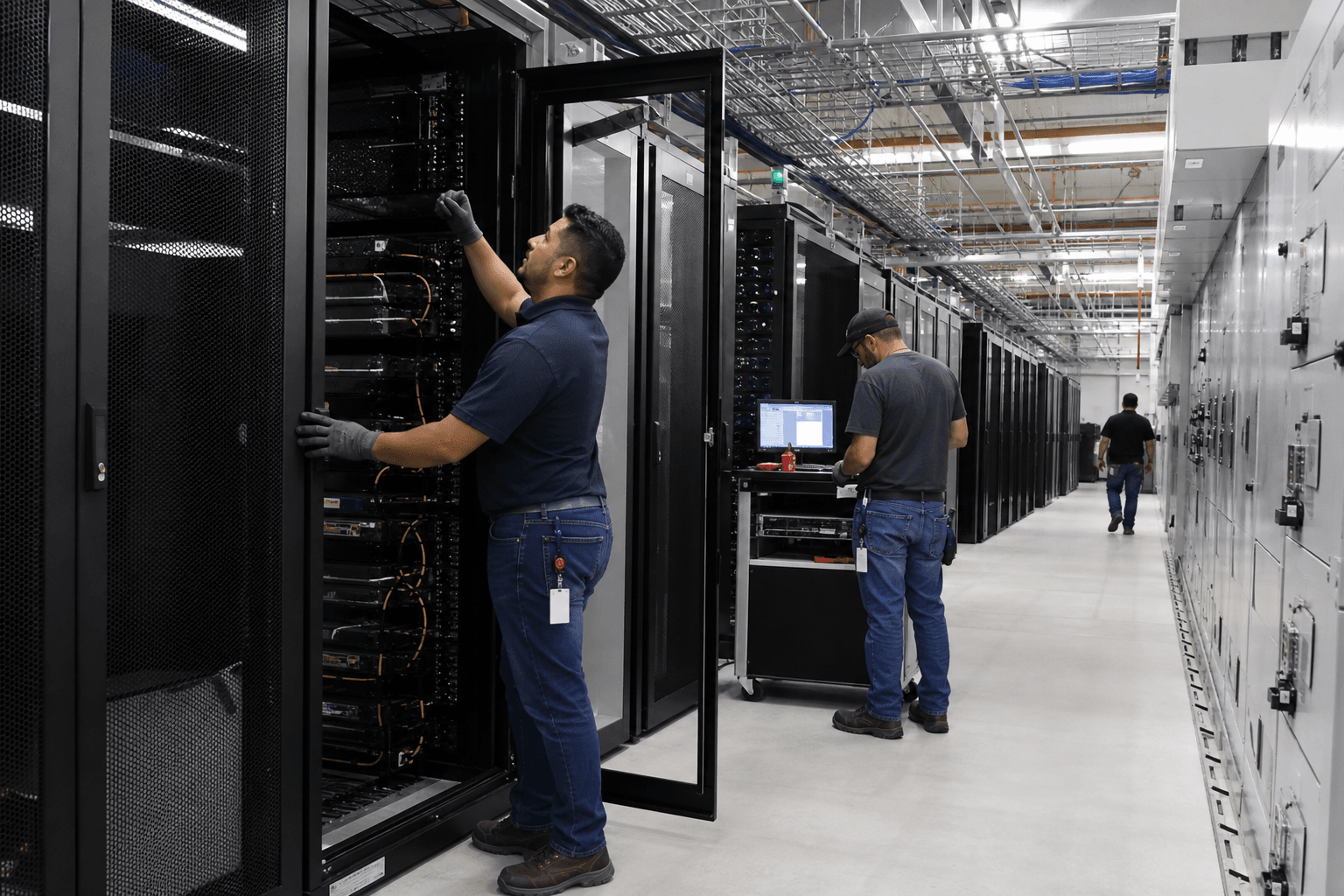
On paper, IREN's May 26 announcement looked like one more AI infrastructure headline: a $1.6 billion purchase of Nvidia Blackwell systems from Dell, headed for the company's Childress, Texas campus. The interesting part is not the hardware. It is who is ordering it.
IREN is the kind of company that makes the current AI market easier to understand. A business that has been transitioning from Bitcoin mining into AI cloud is now signing multibillion-dollar contracts, ordering racks by the billion, and talking about annualized run-rate revenue as if it were a utility expanding generation. That is not a side story. It is the story.
The market keeps describing AI as a software revolution. The money is behaving as if this is an infrastructure land rush.
Walk through the Childress scene for a second. Reuters reported that the Blackwell systems are being installed across IREN's existing Texas data centers and are expected to be ready by early 2027. The company said the deal supports a previously announced five-year, $3.4 billion AI cloud services contract and should lift annualized run-rate revenue to $4.4 billion.
That does not read like a normal tech product cycle. It reads like a capacity conversion project: land, power, cooling, procurement, integration, commissioning, and contract-backed monetization.

That is why I think investors are still slightly looking in the wrong direction. They are staring at model releases, benchmark charts, and chip launches. Meanwhile, a different class of winner is forming underneath them: companies whose real product is delivered megawatts with enough financial credibility to turn those megawatts into contracted compute fast.
IREN basically said this out loud earlier in May. In its business update, management said the world is structurally short compute and that the bottleneck is delivered data-center and GPU capacity. It also said the quarter showed continued progress in transitioning from Bitcoin mining to AI cloud workloads. Strip away the branding and the message is blunt: the scarce asset in AI is not intelligence in the abstract. It is live infrastructure.
That changes how the whole stack should be read.
For years, the dream version of tech investing was capital-light software. Build once, sell repeatedly, add gross margin, avoid heavy assets. AI is moving part of the profit pool in the opposite direction. The companies gaining strategic importance are the ones that can do the boring, expensive things on time:
- secure power before everyone else does
- get land permitted and connected
- finance equipment before revenue fully arrives
- commission racks and networking without slipping quarters
- sell capacity in chunks large customers can trust
This is why IREN matters beyond its own ticker. It is showing that AI demand is strong enough to re-rate a power-dense operator into something closer to an infrastructure franchise.
Even the financing details tell the story. Reuters noted that the Dell purchase price covers not just GPUs, but servers, storage, networking, ancillary equipment, integration services, and warranties, with payments following delivery. That sounds less like buying tech inventory and more like staging a project-finance draw schedule.
Nvidia's earlier agreement to invest up to $2.1 billion in IREN points in the same direction. On the surface, it looks like a strategic partnership. In practice, it also looks like capacity insurance. If frontier AI demand is real and time-to-compute is everything, chip suppliers and model builders cannot just sell parts and hope someone else figures out the site development. They need reliable counterparties that can energize campuses, absorb hardware at scale, and stay solvent through the build.
This is where the Bitcoin-miner-to-AI-cloud transition becomes more than a curiosity. Bitcoin mining taught a generation of operators how to think in megawatts, load density, uptime, hardware refresh, and power economics. AI data centers require a different customer set and a higher service level, but the muscle memory around energy and deployment is not useless. In some cases, it may be exactly the unfair advantage.
That does not mean every former mining operator becomes an AI winner. Plenty will overbuild, overborrow, or discover that not all power is equally monetizable. A megawatt with bad connectivity, weak cooling design, or no customer contract is just an expensive ambition.
But the strategic hierarchy is clearly shifting.
The first AI trade was about who could design the best chips. The second was about who could buy enough of them. The next one may be about who can turn electricity, concrete, and procurement discipline into a trusted compute product before the rest of the market gets a slot.
That is a very different kind of tech story. It is slower, heavier, and less glamorous. It is also where a lot of the money may settle.
If AI really is becoming critical infrastructure, maybe the most important companies in the next leg of the boom will look less like software vendors and more like power brokers in tech clothing.