The AI Infrastructure Trade Is Moving Into the Traffic Layer


The market still talks about AI infrastructure as if the entire prize belongs to whoever sells the most compute. That framing is getting stale. The more useful question now is what happens when companies stop treating AI clusters like isolated boxes and start treating them like giant, expensive traffic systems that have to stay full, synchronized, and productive every hour they are turned on.
Cisco's latest quarter is one of the clearest signs that this shift is already happening. On May 13, the company said networking product orders grew more than 50% year over year, data-center switching orders grew more than 40%, and AI infrastructure orders taken year to date reached $5.3 billion. Cisco also raised its expected fiscal 2026 AI order target to $9 billion from $5 billion. Those are not side effects of GPU demand. They are evidence that the traffic layer around AI is becoming a real profit pool of its own.
What casual readers are missing is that the next durable rent in AI may sit less in raw compute than in utilization. Once clusters run into the gigawatt range, the cost of moving data badly can matter almost as much as the cost of buying chips in the first place. If expensive accelerators are waiting on memory, congested links, or inefficient scale-out, the problem is no longer "not enough AI." The problem is that capital is sitting idle.
That is why Broadcom's recent positioning matters. Its investor site listed an "Enabling AI Infrastructure Investor Meeting" on May 23, and its April 14 announcement with Meta described an initial deployment commitment exceeding 1 gigawatt as the first phase of a multi-gigawatt rollout. Broadcom said the build uses Ethernet networking, optical connectivity, PCIe switches, and high-speed interconnects to eliminate bottlenecks across tens of thousands of nodes. In plain English: the commercial fight is moving from who owns the chip headline to who owns the traffic rules inside the machine.
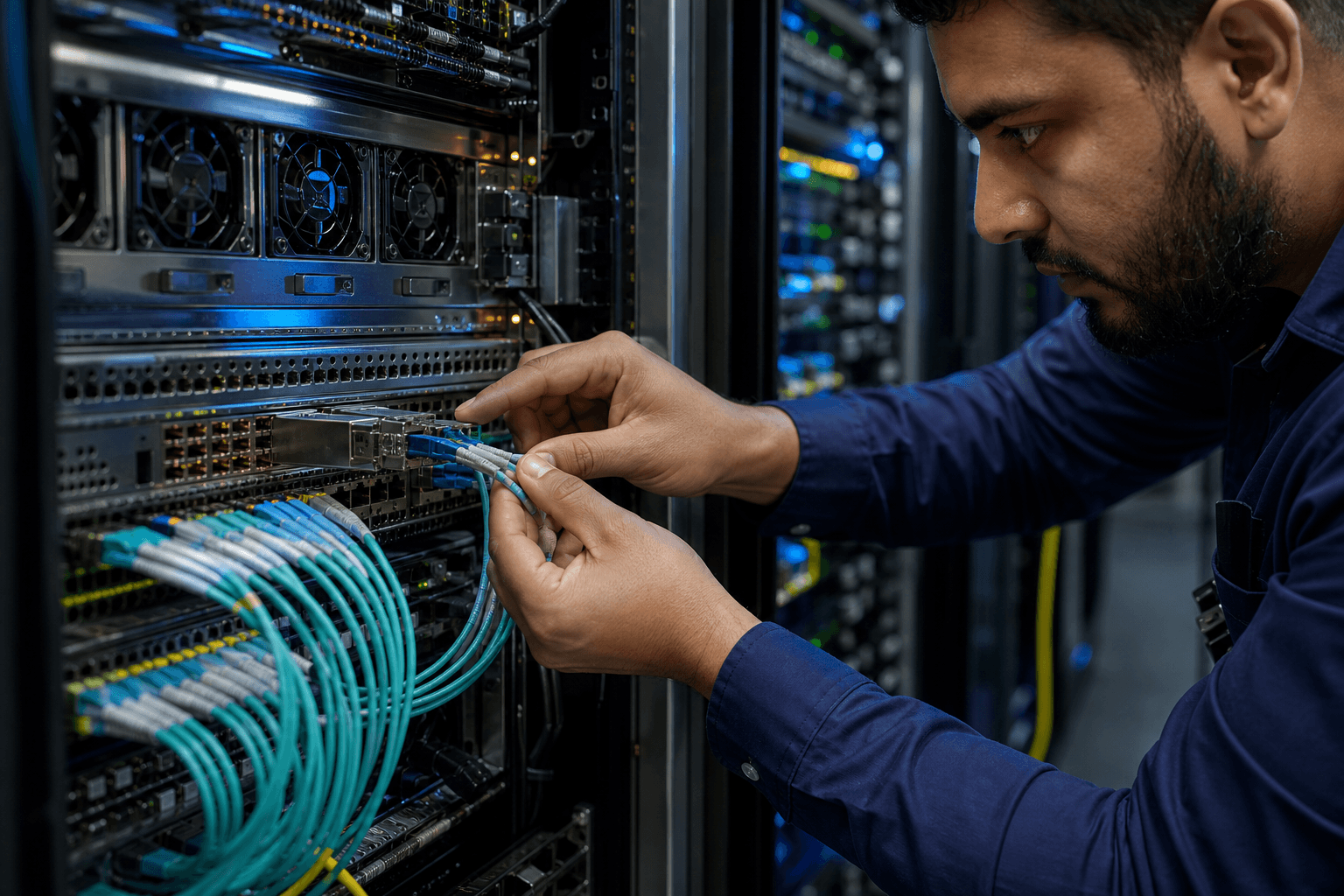
That shift has a business-model consequence investors should care about. Compute is glamorous, but it is also politically noisy, cyclical, and vulnerable to sudden jumps in competitive supply. The network fabric is different. It gets paid whenever customers need more bandwidth, lower latency, denser racks, and better cluster efficiency, whether the workload runs on Nvidia, custom silicon, or some mixed architecture that does not exist yet. The network layer is becoming the neutral infrastructure that monetizes everyone else's ambition.
It also changes how to read corporate capex. A lot of AI spending still gets framed as a binary bet on whether hyperscalers are overbuilding. But networking and optical upgrades are not just expressions of optimism. They are a response to physics and economics. If a company is already committed to billions in accelerators, the follow-on spend that keeps those assets busy can look less discretionary than the first chip purchase. That makes parts of the networking stack feel closer to maintenance capex for a new industrial system than to speculative tech spend.
There is a second-order implication for valuations. GPU winners have captured most of the narrative premium so far because investors can map demand directly to shipments and pricing. The traffic layer is harder to see, so it has often been treated like support equipment. But if the real scarcity shifts from access to chips toward the efficient movement of data across giant clusters, then the vendors selling switches, optics, interconnects, and cluster architecture may deserve more durable multiples than the market has been willing to give them.
This does not mean compute stops mattering. It means compute is maturing into only one layer of the stack. As AI systems get bigger, the question becomes less "who has the best chip?" and more "who can keep the whole machine running at commercial intensity?" That is a different competition, and it favors companies selling throughput, not just teraFLOPS.
The hidden lesson in the latest AI infrastructure news is that the most valuable part of the stack may be the one investors still describe as plumbing. Once the industry starts financing and operating multi-gigawatt AI systems like real infrastructure, plumbing is exactly where pricing power tends to show up.