April PCE Turns Consumer Strength Into a Margin Test

TL;DR: The April 2026 U.S. consumer did not disappear. The problem is more uncomfortable: households kept spending even as disposable personal income slipped, prices rose, and the saving rate fell to 2.6%. That turns the latest BEA Personal Income and Outlays report into a margin warning for retailers, restaurants, card lenders, and consumer-facing stocks that still want to call demand "resilient."
##What April PCE Really Said About the U.S. Consumer
The surface number was fine. Personal consumption expenditures rose $111.1 billion in April, a 0.5% monthly gain in current dollars, according to the Bureau of Economic Analysis.
But the cash-flow detail was less comfortable. Disposable personal income fell $19.9 billion, or 0.1%, while the PCE price index rose 0.4% for the month and 3.8% from a year earlier.
That is not a collapse. It is a squeeze.
The consumer is still handing over the card at the register. The question is whether the spending is coming from better income, weaker saving, more borrowing, or a sharper fight over what gets cut next.
##Why Resilient Spending Is Becoming a Margin Problem
Retailers like to hear that demand is holding. Investors like it too, at least until the next line of the income statement starts moving the wrong way.
If spending rises while real wallet capacity is getting tighter, the sale becomes more expensive to win. A store can still move goods, but it may need more promotions, smaller package sizes, loyalty discounts, free shipping, or financing offers to do it.
#The register is not the same as the household budget
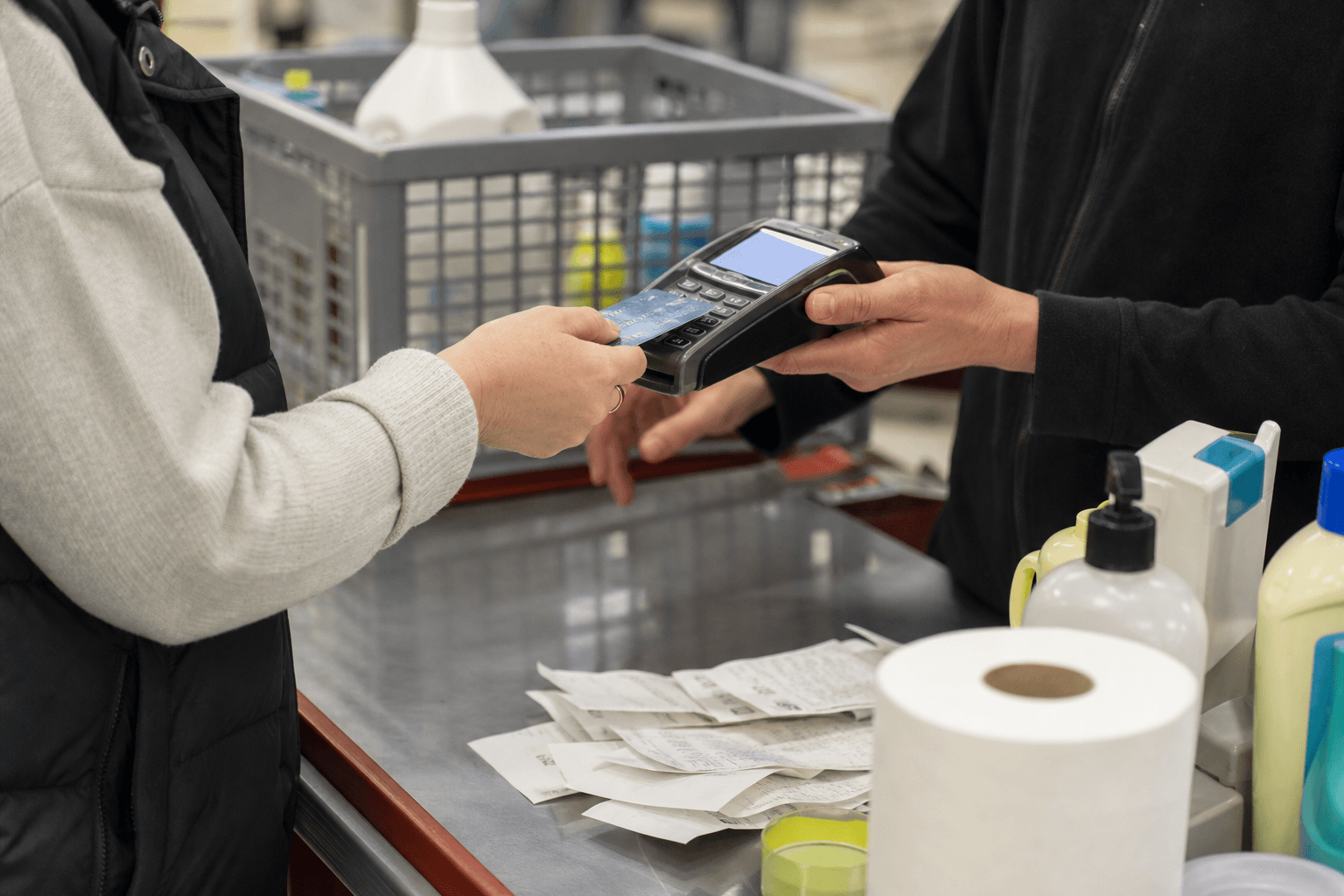
Picture a shopper at a discount-store checkout with detergent, groceries, a pharmacy item, and a payment terminal waiting. The basket still clears.
What changed is not the gesture. It is the math behind it.
At home, the same household is deciding whether April's higher grocery bill means fewer restaurant trips, a delayed clothing purchase, a smaller debt payment, or one more revolving balance. The sale is real, but so is the tradeoff.
That is why April PCE is not just a macro release. It is a read on pricing power.
##Where The Pressure Shows Up First
The obvious mistake is to treat consumer spending as one clean block. It is not.
The April report said current-dollar goods spending rose $44.0 billion and services spending rose $67.2 billion. Meanwhile, the Census Bureau's April retail sales estimate put retail and food-services sales at $757.1 billion, up 0.5% from March and 4.9% from April 2025.
Those numbers can coexist with stress because the stress sits in mix, margin, and payment behavior.
The pressure points are fairly plain:
- Value retailers get traffic, but not automatic pricing power.
- Restaurants can see visits soften before the headline consumer cracks.
- Apparel and home categories become more promotion-sensitive.
- Card lenders earn interest income until delinquency and charge-off math starts pushing back.
- Market indexes can reward revenue growth before they punish the cost of acquiring that growth.
None of this requires a recession call. It only requires accepting that nominal sales are not the same thing as consumer room.

##Who Pays When The Wallet Gets Smaller
The first payer is usually the merchant.
When households are stretched, a retailer cannot simply raise prices and assume loyalty will hold. It has to decide whether to protect gross margin, protect traffic, or protect inventory turns. Protecting all three is the fantasy version.
#Card balances are the second signal
The Federal Reserve's latest G.19 consumer credit report showed consumer credit rising at a 3.2% seasonally adjusted annual rate in the first quarter, with revolving credit up 3.8%.
That does not mean households are reckless. It means credit is one of the bridges between a steady spending habit and a tighter income statement.
For banks and card issuers, that bridge is profitable until it is not. Revolving balances can lift interest income, but they also make underwriting quality more important. A consumer who keeps spending by reducing saving is different from one who keeps spending because wage growth is doing the work.
The equity market often likes the first part of that story and gets surprised by the second.
##Why Investors Should Stop Saying "Strong Consumer" So Casually
"Strong consumer" has become a lazy phrase. April made it less useful.
A better read is this: the consumer is still transacting, but the marginal dollar is getting more contested. That matters because corporate America sells into the marginal dollar, not the average talking point.
For consumer stocks, the April setup asks a sharper question than whether sales are up. It asks how expensive those sales are becoming.
For lenders, it asks whether credit growth is still a clean revenue tailwind or the early accounting layer of household strain.
For the Federal Reserve, it keeps the rate-cut debate awkward. A 3.8% year-over-year PCE price index does not give policymakers an easy victory lap, even if households are visibly more stretched.
The twist is simple: the consumer may look resilient right up to the point where the profit pool stops being resilient.
#FAQ
Why does April PCE matter for investors?
April PCE matters because it showed spending still rising while disposable personal income fell and prices increased. That combination can support revenue headlines while pressuring margins, credit quality, and household saving.
Is this a recession signal?
Not by itself. The point is narrower: nominal spending can stay positive even as households trade down, save less, borrow more, or force companies to spend more to win the same sale.
Which companies are most exposed?
Retailers, restaurants, credit-card issuers, consumer lenders, and discretionary brands are the clearest first-order exposures. The more a business depends on repeat household purchases at full price, the more April's wallet math matters.