Microchip's Data Center Update Makes AI A Factory-Utilization Story

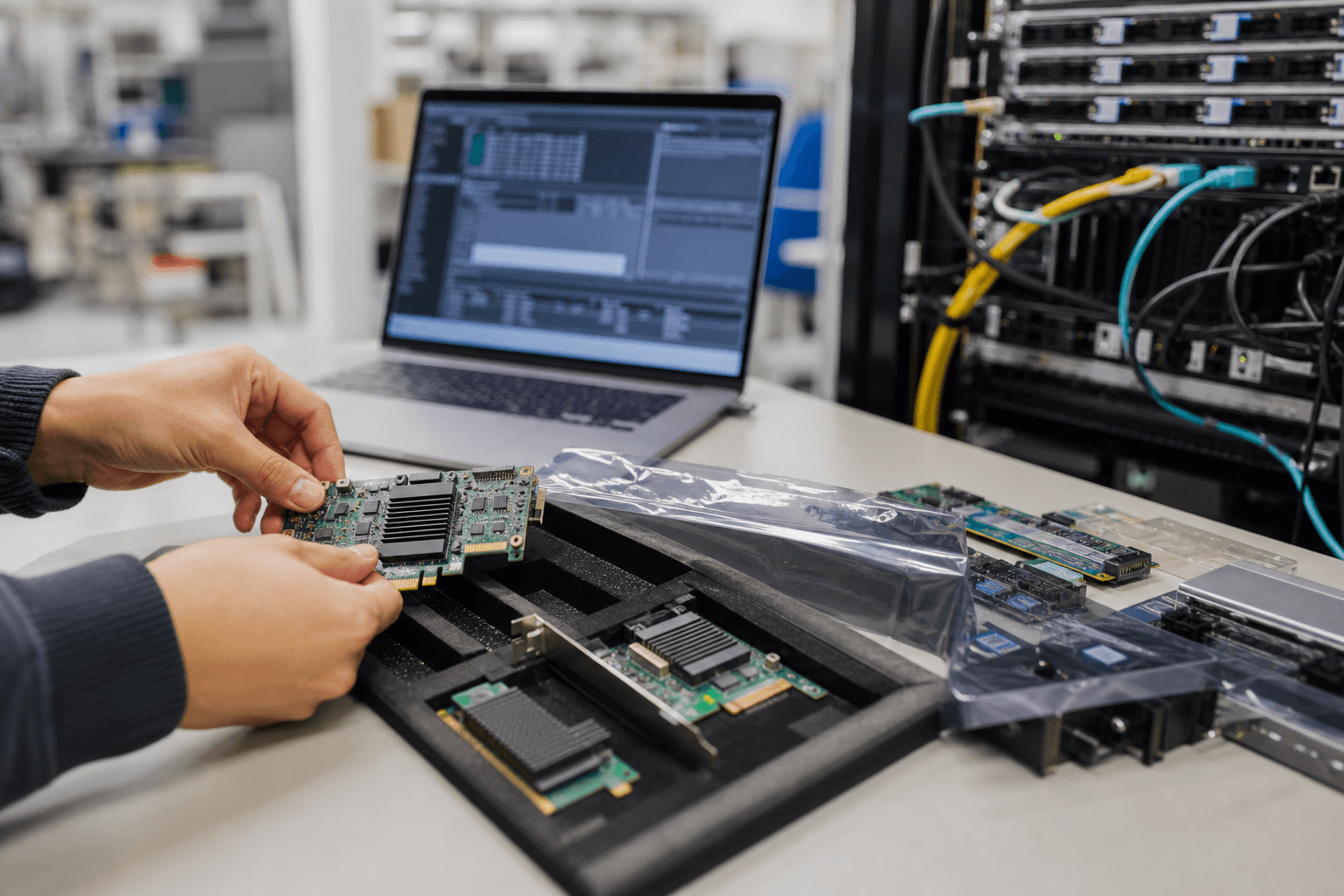
TL;DR: Microchip Technology said its Data Center Solutions unit generated $302.7 million of revenue in calendar 2025 and is expected to grow about 65% to roughly $500 million in calendar 2026. The useful read is not that Microchip has become an AI stock overnight. It is that AI infrastructure spending is now showing up in less glamorous supplier economics: retimer cards, component reels, factory loading, inventory days, and selective price increases.
##What Microchip Just Told The Market
Microchip's June 1 update put a clean number on a business that usually sits behind louder semiconductor stories: $302.7 million of Data Center Solutions revenue in 2025, with management expecting about $500 million in 2026.
That is not Nvidia scale. That is the point.
The AI buildout does not stop at GPUs. It needs power modules, timing, connectivity, storage controllers, FPGAs, security chips, and high-speed PCIe plumbing. Those pieces are not always what investors want to talk about, but they are what procurement teams have to buy before a server rack becomes a working system.

#Why the $500 million number is more useful than the headline
A $500 million data-center unit inside a company with fiscal 2026 net sales of $4.713 billion is big enough to matter, but not big enough to turn the whole company into a pure data-center trade.
That makes it a cleaner signal. It shows where AI demand is leaking into the broader electronics supply chain without pretending every analog and embedded supplier is suddenly a hyperscale winner.
##Why This Is Really About Factory Loading
The overlooked sentence in Microchip's recent earnings release was not the AI language. It was the operating sentence.
Management said lower inventory and improving demand should support higher internal factory utilization, which would help operating leverage and margin targets. That is a very different kind of story from "AI demand is hot."
In a semiconductor downturn, the ugly part is not just lower revenue. It is underused fabs, distributors sitting on too much stock, customers delaying orders, and fixed costs being spread over fewer units.
When demand improves, the math can flip:
- More volume moves through the same manufacturing base.
- Inventory reserves and channel cleanup stop masking demand.
- Expedite activity tells management which parts customers really need.
- Pricing decisions become easier when buyers are trying to secure supply.
This is where Microchip becomes interesting. AI is not merely creating a new product line. It may be helping pull the old operating model out of a downcycle.
##Where The Price Increase Fits
Microchip also said broad-based input cost pressures cannot be fully absorbed and that it plans selective price increases across its portfolio, with no expected impact on guidance or results for the fiscal quarter ending June 30, 2026.
That matters because price increases in semiconductors are not all created equal.
When a supplier raises prices during weak demand, the move can look defensive. When it does so while inventory is normalizing and data-center design activity is improving, the move says customers may have less room to push back on certain parts of the bill of materials.
#The buyer's desk is the real scene
Picture a server hardware buyer, not a stock trader.
The buyer is trying to lock down a build schedule. The GPU allocation already gets attention. But the final system still depends on small parts that keep signals clean, power stable, storage fast, and boards talking to each other.
If one of those parts slips, the expensive box is not shippable. That is why "small" suppliers can suddenly get more important when the whole system is running hot.
##Who Benefits And Who Has To Pay
The cleanest beneficiaries are suppliers with parts that sit in difficult handoff points: connectivity, power, storage, security, timing, and control.
Customers may still negotiate hard. Hyperscalers and server makers do not like surprise cost inflation. But when AI systems become more complex, the penalty for a missing or unreliable component can outweigh the annoyance of a price increase.
For investors, the question is not whether Microchip becomes the next AI darling. That is the wrong frame.
The better question is whether data-center growth can arrive while the rest of the company is also exiting an inventory correction. If both happen at once, the margin effect can be larger than the revenue headline suggests.
##What Investors Should Watch Next
Microchip guided June-quarter revenue to $1.442 billion to $1.469 billion and non-GAAP gross margin to 62.25% to 63.25% in its May earnings release.
Those numbers are the scoreboard, but the useful tells are more operational:
- Whether distributor inventory stays low instead of rebuilding too quickly.
- Whether data-center design wins convert into shipments rather than press-release momentum.
- Whether price increases stick without damaging order rates.
- Whether factory utilization improves enough to show up in gross margin.
This is a boring checklist. That is why it is valuable.
The stock market often wants AI stories to look like giant model launches or giant capex budgets. Microchip's update is smaller and more mechanical. It says the AI buildout is starting to reach the component shelf.
That is where hype becomes purchase orders.
#FAQ
Why does Microchip's data-center update matter for investors?
It shows AI infrastructure demand moving into lower-profile semiconductor categories such as connectivity, power, storage, and control. The financial implication is not just revenue growth; it is whether that demand improves factory utilization and margins.
Is Microchip now a pure AI infrastructure company?
No. Microchip remains a broad embedded, analog, connectivity, and control supplier. The data-center business is important because it can improve mix and operating leverage, not because it replaces the rest of the company.
What is the main risk in this story?
The risk is that design activity and price increases do not convert into durable shipments. If inventory rebuilds too quickly or customers push back on pricing, the margin story becomes much less powerful.