IBM's $5 Billion Open-Source Bet Turns Trust Into a Tollbooth
TL;DR: IBM and Red Hat are not just launching another cybersecurity product. They are trying to turn open-source trust into a paid operating layer for banks and large enterprises.
The real bet behind Project Lightwell is that companies will pay less for "more secure code" than for a reliable way to move open-source components into production without freezing every release meeting. That is a business-model shift, not a feature launch.
#The Desk Where This Gets Decided
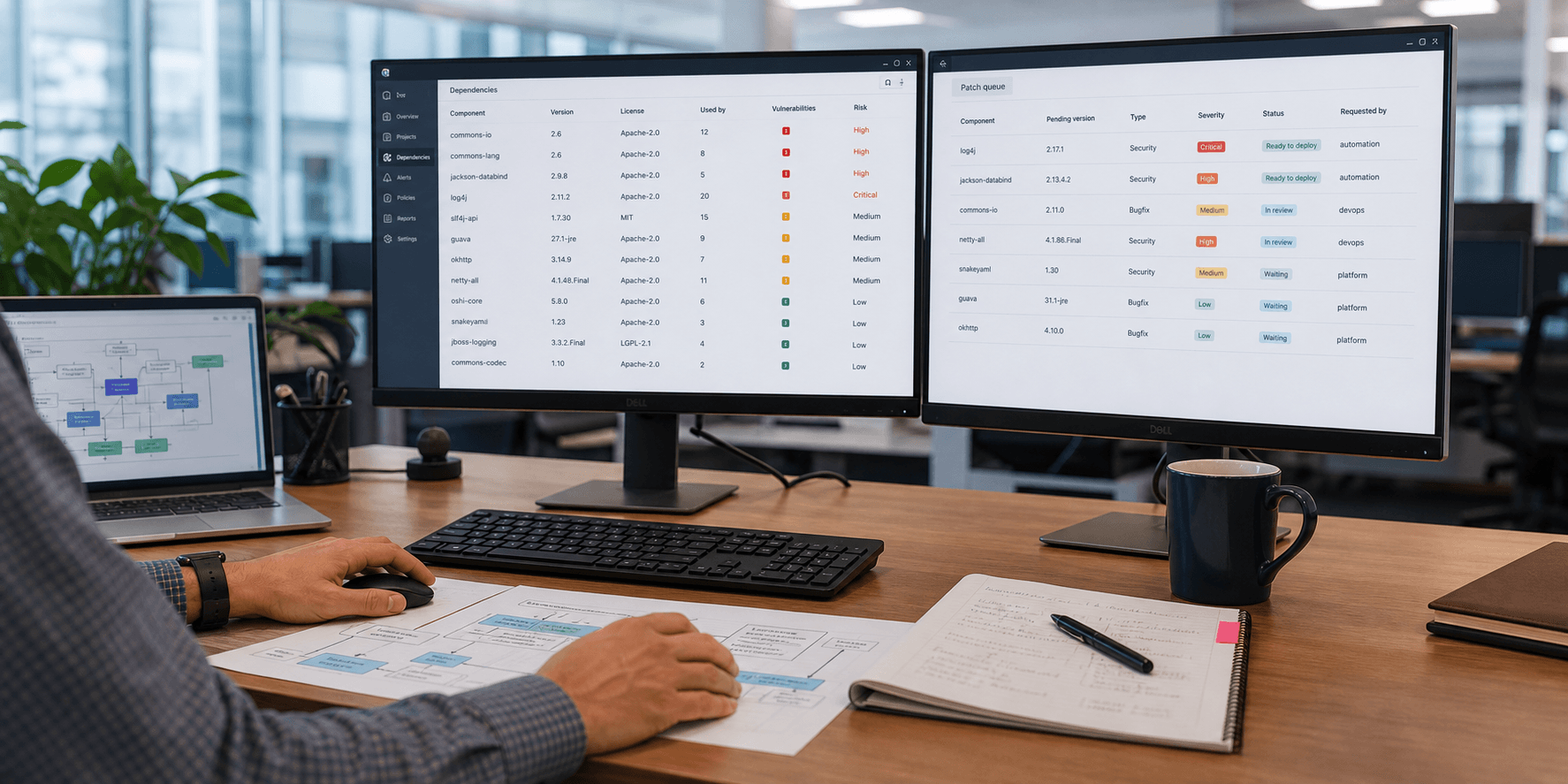
Picture the kind of desk that decides whether a software release ships this week or slips into next month.
Two screens are open. One lists dependencies and vulnerability alerts. The other tracks patch status, approvals, and which internal system owner is willing to sign their name under "ready for production." The bottleneck is not discovering another flaw. The bottleneck is deciding which fix is trustworthy enough to let into a live environment.
That is the scene IBM is selling into. Reuters reported that Project Lightwell has already been piloted with companies including Bank of America, JPMorgan Chase, and Visa, and that IBM expects a commercial launch within 30 days with subscriptions likely priced by the number of packages used.
#Why This Is Not Really a Cybersecurity Story
Of course it is about security. But that is not the interesting part.
The interesting part is that IBM and Red Hat are trying to stand between open-source abundance and enterprise hesitation. Red Hat says more than 90% of Fortune 500 companies rely on open-source software, while IBM says the clearinghouse model would help customers report flaws confidentially, receive tested fixes, and feed those fixes back upstream.
That means the product is not simply "we found a bug." The product is workflow confidence.
If you are a bank, an insurer, or a giant healthcare operator, the expensive failure is rarely the first vulnerability alert. The expensive failure is the patch that breaks a payment flow, a claims engine, or an internal model after change control has already signed off.
#What IBM is actually selling
IBM is selling a production-grade trust stamp.
Reuters quoted IBM software chief Rob Thomas describing Lightwell as a way to give clients a "stamp of approval" that open-source software is safe to use in production. That language matters. It sounds less like a developer tool and more like an outsourced release committee.
That is why this could matter financially. A trusted intermediary can charge for lower friction, lower delay risk, and lower blame. Those budgets do not only come from security teams. They come from procurement, operations, compliance, and the business units that are tired of waiting.
#AI Makes the Human Layer More Valuable
The cleanest read-through from this announcement is not that AI will automate software security away.
It is the opposite. Red Hat said the program is backed by more than 20,000 engineers. Reuters said AI is making it easier for attackers to find and exploit flaws. Put those together and the market signal is clear: when machine-generated code and machine-discovered vulnerabilities multiply, tested human remediation becomes more valuable, not less.
That is the part many investors miss when they hear "AI-driven cybersecurity." They imagine margins expanding because software does more of the work. IBM is signaling something different. The moat may sit in combining AI triage with expensive engineering labor and enterprise accountability.
#Why banks showed up first
Banks are the perfect early customers because they already know the hidden cost of dependency sprawl.
A consumer app can shrug off some open-source messiness. A bank cannot. The more regulated the workflow, the more valuable a third party becomes if it can collapse package review, patch validation, and audit evidence into one repeatable motion.
In that sense, Lightwell looks less like a classic cyber product and more like plumbing for high-consequence software change management.
#The Business Model Hiding Inside the Announcement
The clever part is the pricing logic.
If subscriptions are tied to the number of packages, as Reuters reported, then the economic engine scales with software complexity itself. That is a smart place to sit. Modern enterprises are not simplifying their dependency trees. They are adding AI frameworks, data tools, orchestration layers, and more third-party code every quarter.
So IBM is not betting that companies will someday write cleaner stacks. It is betting that dependency sprawl is permanent, and that enterprises will increasingly pay to industrialize trust around it.
That has second-order consequences:
- More security spend can move out of one-off incident response and into recurring operating budgets.
- Large vendors with enterprise distribution and support capacity gain an advantage over point tools that only generate alerts.
- Open source becomes less "free" in practice, because validated use in production starts to look like a subscription service.
#The Twist
For years, the big open-source promise was freedom from vendor lock-in.
Project Lightwell hints at a different future. The code may stay open, but the confidence layer around that code may become one of the most valuable closed commercial products in enterprise infrastructure.
That would be a quiet but meaningful shift: not from open source to proprietary software, but from open source as shared code to open source as paid clearance.
#FAQ
What happened?
IBM and Red Hat announced Project Lightwell, a $5 billion initiative to secure open-source software with AI capabilities and a large engineering workforce, and said it has already been piloted with major financial institutions.
Why does this matter for business readers?
Because the commercial value is not just better security tooling. It is the chance to own a new tollbooth in enterprise software: the step where companies decide whether fast-moving open-source code is safe enough to become billable production work.