Ciena's Quarter Says AI Needs a Traffic Budget


TL;DR: Ciena's June 4 quarter is not just another AI-adjacent earnings beat. It shows that the AI buildout is moving into a less glamorous but more durable line item: bandwidth. When revenue jumps to $1.57 billion, up 40% year over year, and management lifts full-year guidance only one quarter after guiding for $1.5 billion plus or minus $50 million in Q2 revenue and $5.9 billion to $6.3 billion for fiscal 2026, the useful read is not "AI still hot." The useful read is that hyperscalers are now paying to move AI traffic, not just to create it.
##Why This Quarter Matters More Than The Stock Move
Most people still picture the AI spending boom as a chip story.
That was fine when the main debate was who could get enough GPUs. It is less fine now. Once those clusters are installed, the next constraint is whether the data, training traffic, and inference requests can move fast enough between racks, campuses, and regions to keep the expensive compute busy.
That is why Ciena's quarter matters. The company reported adjusted operating margin of 19.5%, up from 8.2% a year earlier, and raised fiscal 2026 revenue guidance to $6.3 billion plus or minus $100 million. A boring network supplier is not supposed to print results that look like this unless the customer problem has become urgent.
The sharp point is simple: AI capex is no longer just a silicon budget. It is becoming a traffic budget.
##What The GPU Story Misses
Look at the physical workflow, not the AI keynote.
An operations manager does not get paid because a model benchmark looks good on a slide. They get paid when the cluster trains on schedule, inference latency stays acceptable, and the expensive hardware does not sit around waiting on a slower network layer.
That changes what buyers are optimizing for.
#Bandwidth is turning into utilization insurance
In March, Ciena said new photonics, 1600ZR/ZR+ pluggables, coherent transponders, and automation software were designed to meet surging AI-driven bandwidth demand. That language sounded promotional then.
After this quarter, it looks operational.
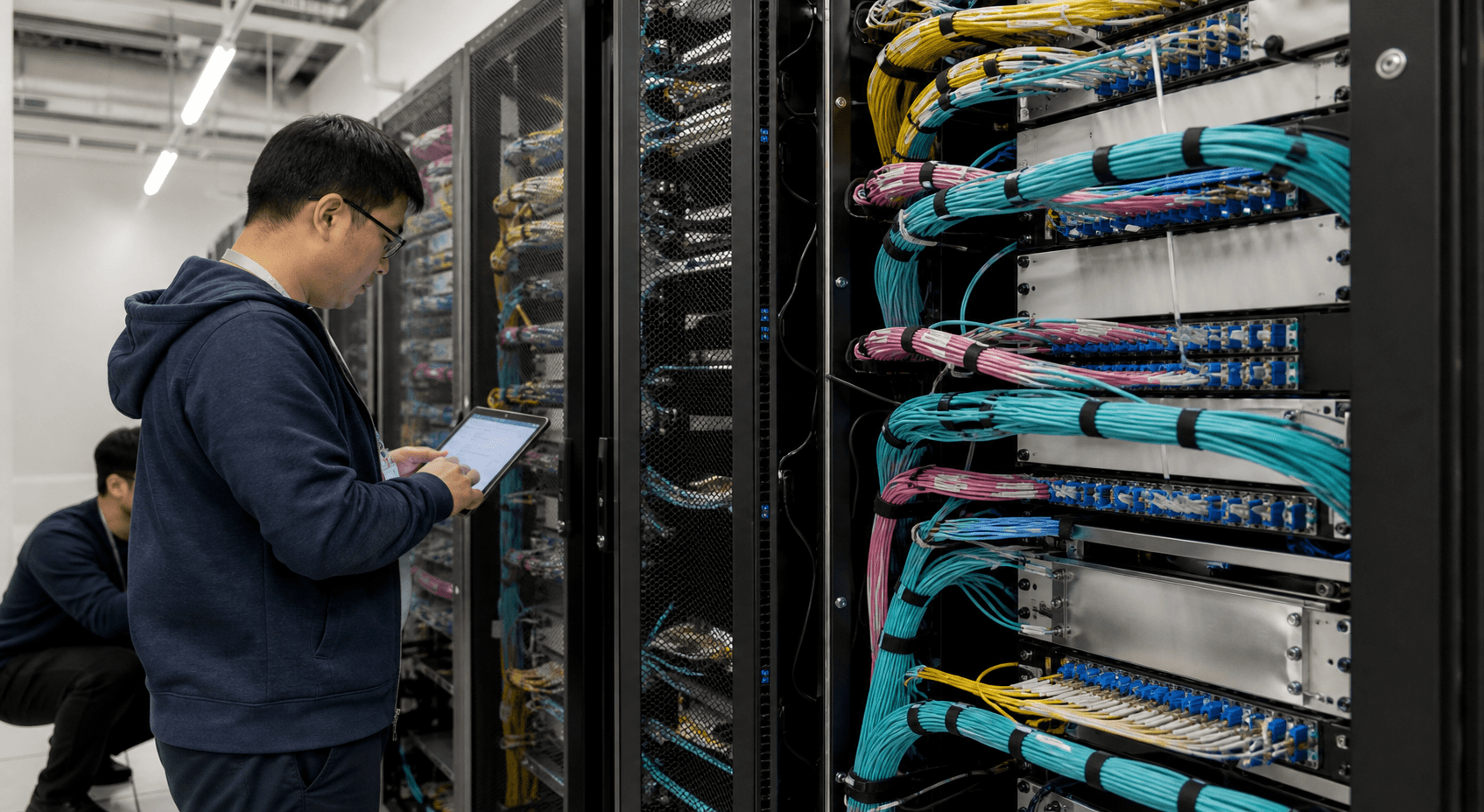
If hyperscalers and large cloud builders are still buying aggressively after the first GPU wave, they are not buying pretty network diagrams. They are buying utilization insurance. The network is what keeps a costly AI cluster from behaving like stranded capital.
#The spend is moving out from the chip
This is the part casual readers miss.
The first wave of AI enthusiasm rewarded the companies that made or packaged scarce compute. The second wave should reward whoever helps customers prevent that compute from idling. In practice, that means optics, interconnects, routing, automation, and all the ugly planning work around capacity handoffs.
##Where The Real Buying Decision Happens
Picture a planning desk inside a cloud infrastructure team.
There is a capacity spreadsheet, a rollout calendar, a procurement note on optical gear, and a map of which data-center links need to be upgraded before the next cluster comes online. Nobody at that desk is debating whether AI is real. They are debating whether the network path can support the next revenue promise.
That is why Ciena's guidance increase matters more than the beat itself.
One quarter ago, management told investors to expect about $1.5 billion in Q2 revenue and $5.9 billion to $6.3 billion for the year. On June 4, it delivered $1.57 billion in Q2 revenue and raised the midpoint logic by tightening full-year guidance around $6.3 billion.
That is not just demand. That is conversion.
##Why Investors Should Care
The market still talks about AI infrastructure as if the value mostly sits at the compute layer.
It does not. Not anymore.
Once spending gets large enough, every adjacent layer that protects utilization starts to matter more. Power did this earlier. Now the network fabric is doing the same thing. The surprise is not that bandwidth demand exists. The surprise is how quickly it is becoming a financially visible bottleneck.
#This shifts the winner set
If this read is right, the next group of AI infrastructure winners will not be limited to chip designers and cloud landlords.
It will include the companies that help customers move data with enough speed and reliability to justify the original compute spend. That is a less cinematic business, but often a better one, because it sits closer to an operating necessity than to a hype cycle.
#It also changes how to read capex
Investors should stop treating networking spend as a sidecar to the AI trade.
It is becoming part of the core invoice. And once that happens, the question changes from "Who sells AI?" to "Who keeps the AI system fully loaded?"
That is a better question because it points away from launch headlines and toward workflow reality.
##The Twist
Ciena's quarter is easy to file under "another beneficiary of AI."
I think that misses the better lesson.
The AI boom is maturing when the money starts moving toward the parts of the stack that users only notice when they fail. Chips create the excitement. Networks protect the return on the excitement.
That makes this quarter less a celebration of tech demand than a sign that AI is becoming ordinary capital planning. And ordinary capital planning is where the durable money usually gets made.
#FAQ
What did Ciena report on June 4, 2026?
Ciena reported fiscal second-quarter 2026 revenue of $1.57 billion, up about 40% year over year, adjusted EPS of $1.64, and raised fiscal 2026 revenue guidance to $6.3 billion plus or minus $100 million.
Why is this relevant beyond one company?
Because the results suggest AI spending is broadening beyond chips and servers into the networking layer that keeps large clusters, campuses, and cloud traffic operating efficiently.
What is the business takeaway for investors?
The next durable AI infrastructure winners may be the companies that protect utilization by solving bandwidth, interconnect, and network-automation bottlenecks, not only the companies selling the most visible compute hardware.