Nvidia Found 80 New Data Centers. Someone Near Them Is Paying for It.


Nvidia just had the kind of quarter that makes analysts run out of adjectives. Eighty-two billion in revenue. Profit up triple digits. The CFO bragged that the company is now standing up AI compute in more than 80 sites that each pull over 10 megawatts. The stock fell 1.8% the next day.
That drop is the part everybody wrote about, and it's the least interesting thing here.
What caught me was the framing. Nvidia spent the call selling a new story: it doesn't need the giant cloud companies anymore. There's this whole second bucket now, christened ACIE, which is finance-speak for everyone who isn't Amazon or Google. Sovereign
governments. Old-line enterprises. Standalone AI clouds. It came in at $37 billion, basically dead even with the hyperscalers. AI cloud revenue more than tripled year over year. The pitch writes itself. We used to lean on four customers. Now the demand is everywhere.
Everywhere. Sit with that word a second.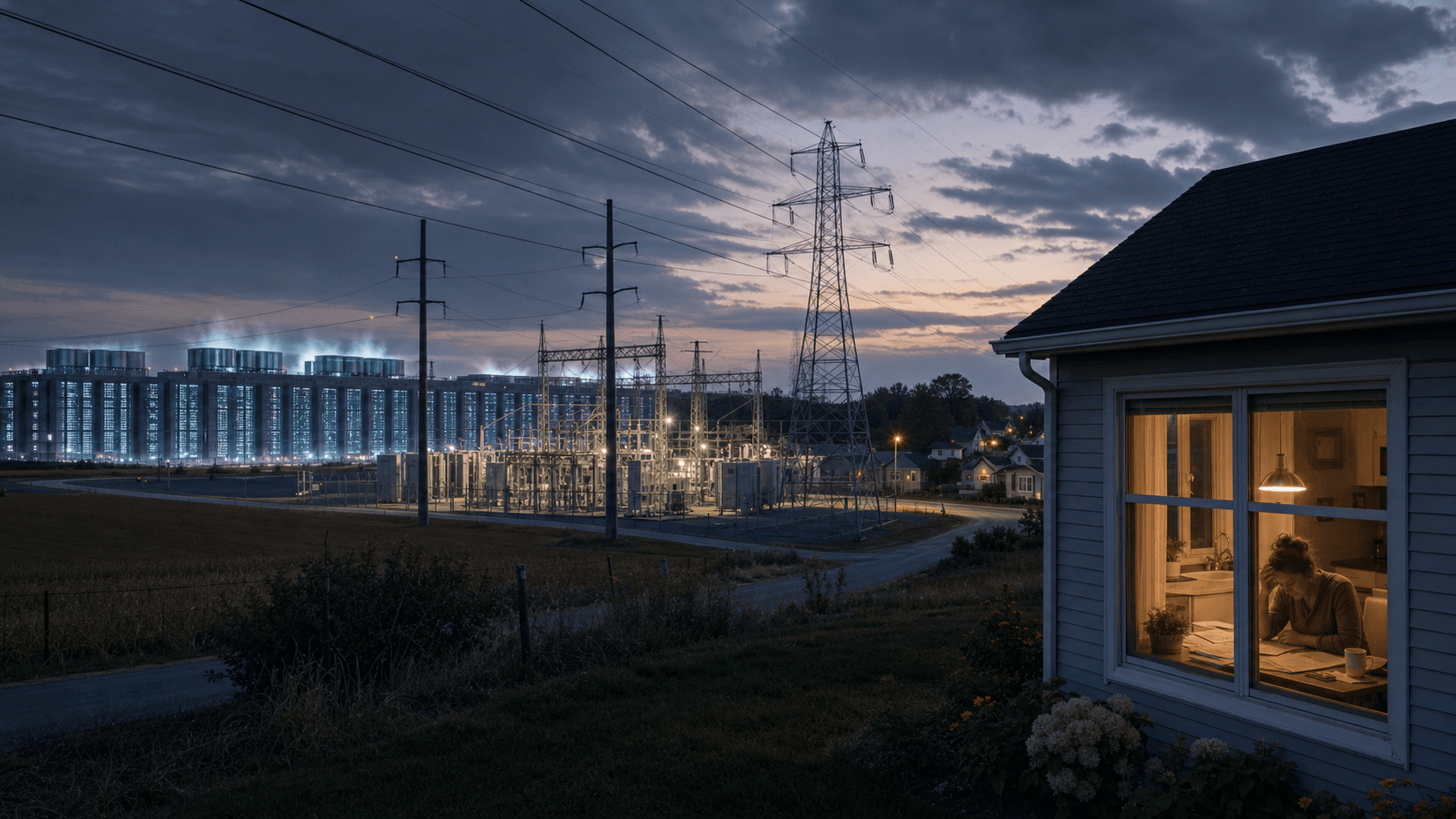
Because "everywhere" is also where the power has to come from. Those 80-plus sites Colette Kress mentioned with such pride, each eating more than 10 megawatts, do not run on enthusiasm. They run on the same grid your refrigerator does. And the bill for hooking them up, the new substations and transmission lines, the utilities mostly spread across every ratepayer on the system, whether or not a single server in that building does anything for you.
You can watch it land. In Georgia, a typical household power bill has climbed to around $175 a month, roughly six times higher across two years, while the utility asks to spend $15 billion more on capacity it needs mostly to feed data centers. A woman outside Atlanta told a reporter the price was running her pocket. That's the voice that doesn't make it onto the earnings call. There's no slide for her.
This is the quiet handoff nobody on the call names. The article I read about the quarter called it "a business beyond hyperscale," like that's pure good news, a company outgrowing its dependence. Read it from the other end of the wire and it says something flatter: Nvidia found a way to sell chips into towns that never asked for them, and the people in those towns are picking up part of the electric tab.
I'm not pretending Nvidia is doing something illegal, or even unusual. They sell shovels. The gold rush is real, the demand is real, and the diversification story is probably true on its own terms. Fourteen straight quarters of beating Wall Street isn't an accident. But there's a reason the stock yawned at a blowout. The market has priced in perfection, sure, that's the polite analyst version. The rougher version is that a $5 trillion company growing 85% a year has gotten so big it stopped feeling like a stock and started feeling like weather. And weather has downstream effects on people who never check the forecast.
So when the next earnings call brags about lighting up data center number 81, somewhere in rural Pennsylvania a room full of neighbors is showing up to a township meeting with handwritten signs, trying to keep number 81 out of their backyard. Both things are this quarter. Only one of them gets a number on the slide.
The analysts asked Nvidia about the segmentation change. They asked about the CPU. Nobody asked who's paying for the megawatts.