AI's Next Chip Bottleneck Is the Power Bill
TL;DR: The AI chip race is no longer mainly about who can squeeze out more raw compute. It is becoming a utility economics story. When TSMC says customers now want energy efficiency more than brute-force performance, that is a sign the bottleneck has moved from transistor bragging rights to the cost and availability of electricity, cooling, and system design.
##The AI Boom Has Reached the Power Socket
One useful scene sits inside a data center budget meeting, not a chip lab.
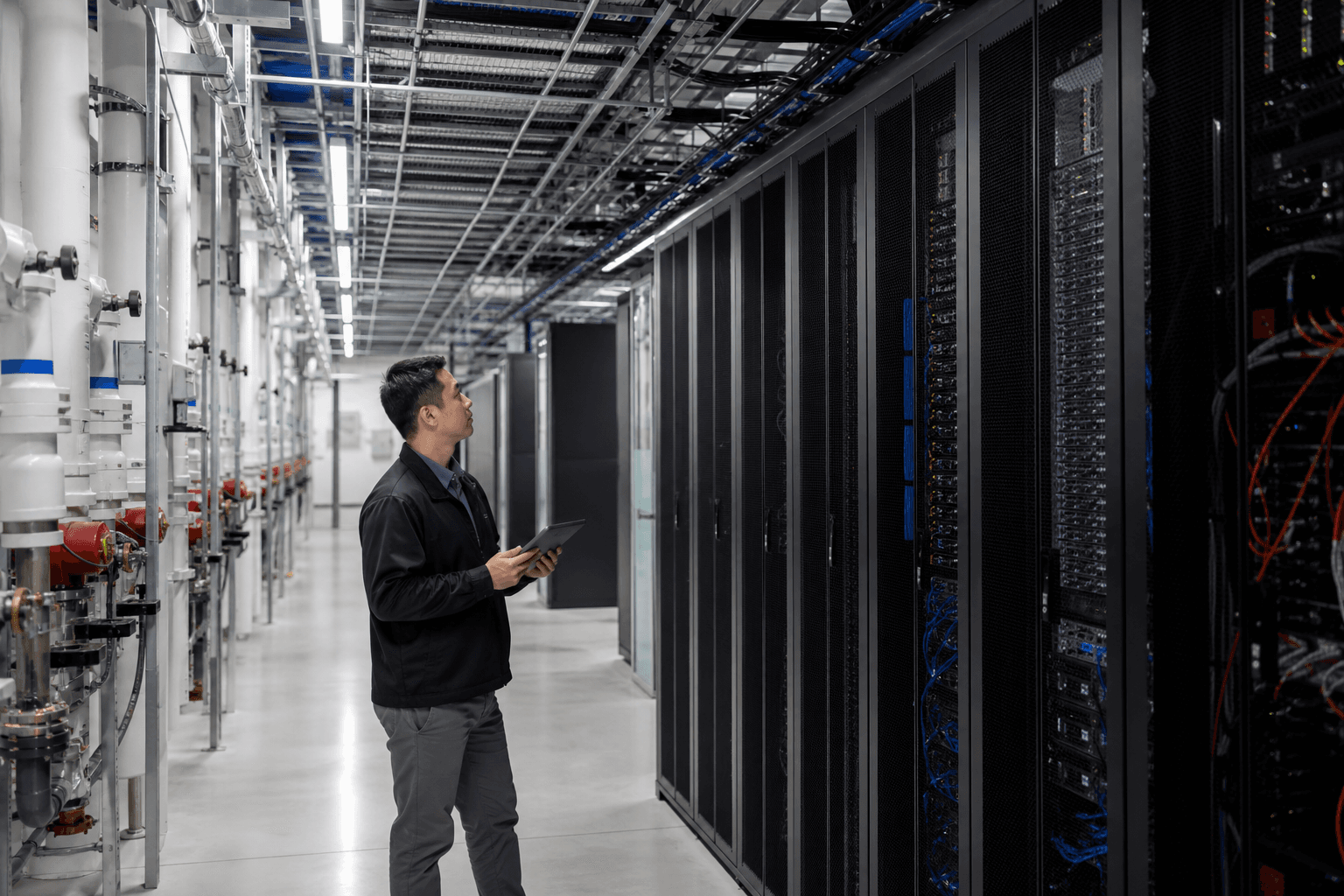
The operator is not asking for another slide about model intelligence. The operator is asking whether the next cluster can fit inside the power envelope, whether the cooling plant can keep up, and whether the utility will deliver enough capacity on schedule. That is why TSMC senior vice president Kevin Zhang said this week that surging AI electricity demand is making energy efficiency, not just computing power, the main constraint shaping chip development, according to Reuters.
That statement matters because TSMC sits in the middle of the AI capex stack. Its customers include Nvidia, AMD, and custom-chip buyers such as Google, Amazon, Meta, and Microsoft, as Reuters noted. When the foundry at the center of that network starts framing the problem around watts, investors should stop talking as if more demand automatically means more value for every layer of the stack.
The market still talks about AI chips as a performance race. The business reality is starting to look more like a power-allocation race.
##Why This Changes What Counts as a Winner
TSMC is not saying performance stopped mattering. It is saying performance that blows out the power budget is becoming less useful.
That shows up in the company’s own roadmap. On its official A14 technology page, TSMC says A14 is on track for volume production in 2028 and should offer either 10% to 15% higher speed at the same power or 25% to 30% lower power at the same speed versus N2. That is not a cosmetic engineering detail. It is a business promise aimed at customers who need more output without rewriting the entire electrical and cooling plan around each new generation.
TSMC’s latest results explain why customers care so much. The company reported first-quarter 2026 revenue of $35.90 billion and guided for $39.0 billion to $40.2 billion in the second quarter. This is a giant market already. At that scale, the next improvement does not need to be merely faster. It needs to be deployable.
#Deployable beats theoretical
A chip that is 20% better on paper but forces new racks, more transformers, more cooling, and slower site approvals can be economically worse than a chip that delivers less headline speed but better performance per watt.
That is the shift many casual readers are missing. AI infrastructure is maturing from a product cycle into an operating-cost discipline.
##Taiwan Is Becoming an AI Systems Market, Not Just a Chip Market
The second useful scene is not inside a fab. It is in Taipei, where Computex has turned into an infrastructure show.
Reuters reported that Nvidia CEO Jensen Huang said his company would spend as much as $150 billion a year in Taiwan, while AMD CEO Lisa Su said AMD would invest more than $10 billion in Taiwan’s AI sector. Reuters also noted that Taiwan’s server exports surged to $60 billion last year from just $571 million in 2017, and quoted McKinsey’s Ryan Fletcher saying Taiwan’s role is moving from a semiconductor story to an infrastructure story.
That is the real point.
The question is no longer only who gets wafer capacity. The question is who can turn chips into powered, cooled, networked, serviceable systems fast enough to monetize demand. Nvidia’s own Computex page makes that emphasis explicit: the company is showcasing AI compute, AI infrastructure, and an AI Factory MGX ecosystem showcase, not just isolated chips.

#This is where margins can move
If power and serviceability become binding constraints, value shifts toward the layers that solve deployment friction:
- Advanced packaging and system integration.
- Power distribution and thermal management.
- Data center networking that reduces wasted energy and latency.
- Contractors and suppliers that shorten the path from chip order to revenue-generating cluster.
That does not make GPUs less important. It makes them less sufficient.
##What Investors and Operators Should Watch Now
The cleanest way to misread the AI trade is to assume every hardware winner stays a winner for the same reason.
Early in the boom, scarcity itself did most of the work. If you had access to top-end accelerators, you won. In the next phase, the scoring changes. Investors need to ask which companies help customers turn expensive silicon into productive output under real-world power limits.
That means watching a different set of questions:
- Are chip gains reducing total system power per useful workload, or just raising performance?
- Which suppliers help hyperscalers add capacity without waiting years for site redesigns?
- Which companies benefit when buyers choose packaging, cooling, networking, and power optimization over raw chip count?
- Which AI valuations still assume that demand for compute can ignore the cost of electricity?
This is also where some software narratives get tested. If the infrastructure bill rises because each incremental model run demands more power and more balance-sheet commitment, customers will pressure software vendors to prove real return on that spend. Utility economics eventually flows uphill.
##The Hidden Repricing Ahead
The AI boom is not slowing because power matters. The opposite is more likely.
It is getting more industrial.
That usually means fewer fantasy narratives and more repricing around bottlenecks that operators actually pay for. In the first phase of the AI trade, the scarce asset was top-end compute. In the next phase, the scarce asset may be the ability to deliver useful compute within a tolerable power bill.
That is a different market.
It rewards engineering, yes. But it also rewards the companies that think like utilities, landlords, and systems integrators. The chip race is still on. It just may be won in the electrical room.
#FAQ
Why is power efficiency suddenly such a big AI business issue?
Because AI clusters are becoming so large that electricity availability, cooling, and operating cost can block deployment even when demand for compute is strong. TSMC said this week that customers are prioritizing energy efficiency across devices and AI data centers.
Does this mean raw chip performance matters less now?
Not less in absolute terms. It matters differently. Performance that cannot be deployed economically under real power constraints is less valuable than performance that fits existing infrastructure more efficiently.
Why does this matter for U.S. investors?
Because the next AI winners may not be defined only by chip demand. They may be defined by who captures spending on packaging, networking, cooling, site buildout, and power-aware system design as hyperscalers turn AI capex into long-duration infrastructure.