The USMCA Review Is Turning the Cheap Car Into a Compliance Product

TL;DR: The U.S. push to toughen USMCA auto rules is being framed as a manufacturing victory. The sharper business read is less flattering: it risks turning the cheapest cars sold in North America into compliance-heavy products. If a vehicle has to clear higher regional-content tests and a new U.S.-specific content floor, the easiest place for automakers to protect profit will be higher-margin trucks and crossovers, not entry-level models.
That matters because the latest U.S.-Mexico talks are not abstract diplomacy anymore. Reuters reported on May 29, 2026 that U.S. negotiators want North American-built vehicles to reach 82% regional content, with 50% of total value produced in the United States. Two days earlier, Reuters had already reported that the first formal round was centered on automotive rules of origin, steel and aluminum, and a U.S.-specific content minimum. The USTR confirmed the May 29 round ended with those topics at the center and set follow-up talks for June 16-17 in Washington.
#The market will feel this first in the cheap seats
The clean political slogan is "more American content."
The messy operating reality is a purchasing manager staring at a parts matrix and asking which seat frame, wire harness, stamped bracket, and battery subassembly can still qualify without blowing up cost.
That is why the first pressure point is not the luxury end of the market. It is the budget end.
High-margin vehicles have room to absorb supplier reshuffling, extra auditing, dual sourcing, and the occasional decision to localize a component that used to come from somewhere cheaper. Low-priced vehicles do not.
#The rule change is really a margin change
USMCA already raised the bar versus old NAFTA. USTR's 2026 Trade Policy Agenda says the current deal requires 75% regional value content for autos, 70% North American sourcing for steel and aluminum purchases, and 40% to 45% labor-value content at $16-an-hour facilities.
Those are not small asks. They are supply-chain accounting systems.
Moving the bar from 75% to 82%, then layering in a 50% U.S.-specific value threshold, does not just change where parts come from. It changes which vehicles are worth the trouble.
An expensive pickup can carry more compliance cost. A premium SUV can bury more logistics friction inside the sticker price. A compact sedan or low-end crossover has much less room to hide anything.
#This is why the low end gets squeezed
Automakers do not price all vehicles the same way. Entry models often exist to keep a customer in the brand, hit fuel-economy mix targets, or fill dealer lots with something that looks affordable from the curb.
If rules-of-origin compliance gets harder, companies have three blunt options:
- raise prices on the cheapest models
- strip features to defend gross margin
- reduce model variety and push buyers up the price ladder
All three outcomes are commercially rational. None of them look like a win for affordability.
#The real product becomes traceability
Look at the desk first, not the showroom.
The person who wins this fight inside an automaker is not the ad agency. It is the sourcing, customs, and finance team that can prove origin fast enough to keep the line moving and the tariff treatment intact.
That is why this story belongs in business pages more than political ones. The scarce asset is not patriotism. It is verified traceability across thousands of components.
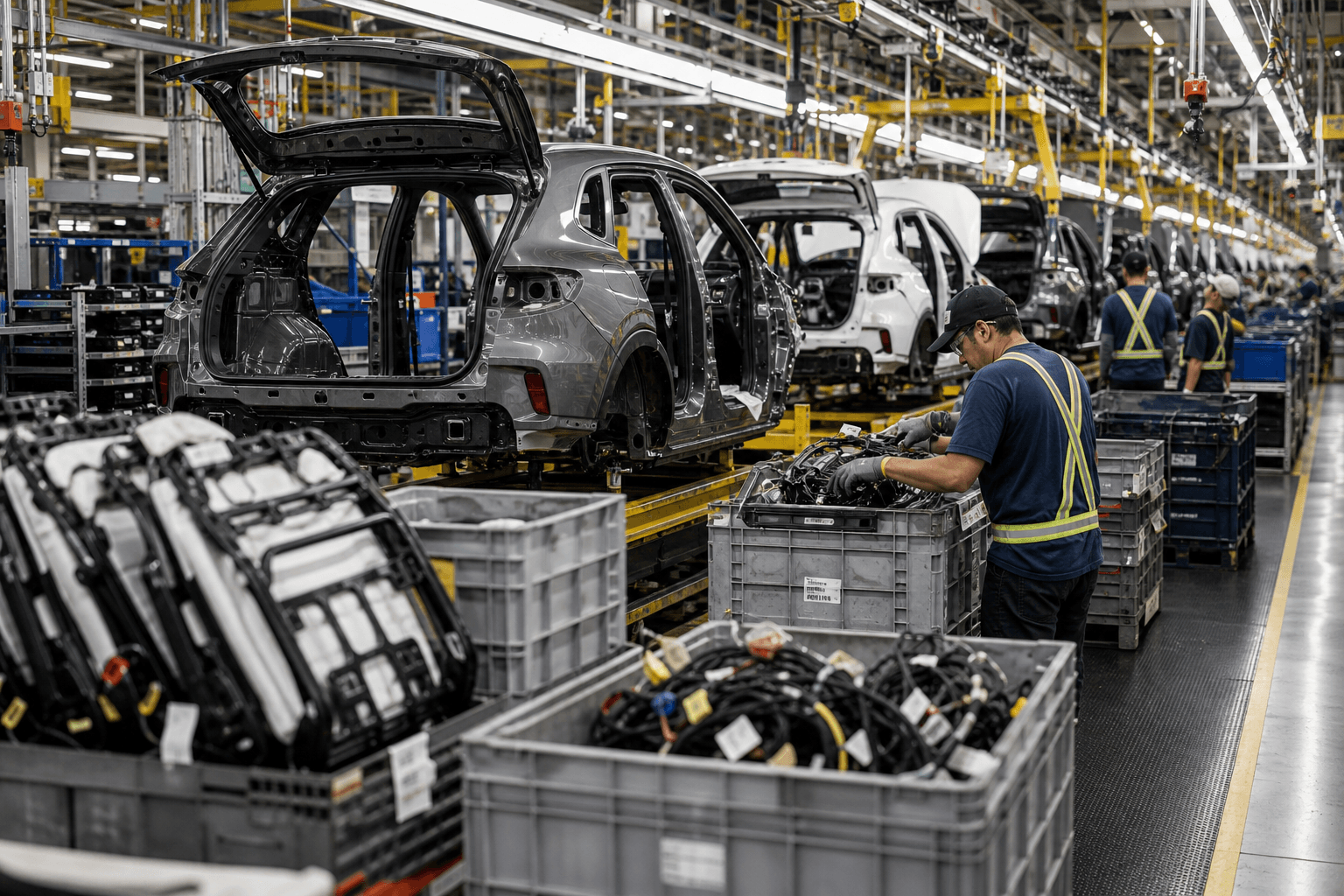
A plant can physically assemble vehicles while still losing money on the wrong compliance mix. It can also keep the line running but shift production toward the nameplates with the best margin cushion.
#Bigger companies have a quieter advantage
Scale helps here in boring ways that matter.
Large automakers can spread compliance software, supplier development, legal review, and origin auditing across more volume. They can threaten to move purchasing. They can finance retooling. They can negotiate with suppliers that smaller or import-heavy players need more desperately.
That does not make them invincible. It does make them better positioned than any brand relying on a thin-margin, low-price formula.
#The supply chain will not rewire evenly
One mistake in the public conversation is to assume stricter content rules automatically create a neat wave of domestic investment.
Some production will localize. Some suppliers will win. Some steel and parts businesses will gain leverage.
But some models will simply become less attractive to sell in North America on current economics. Reuters noted the U.S. proposal was presented during bilateral talks that are supposed to ensure the agreement benefits American supply chains. That is a real goal. It is just not the same thing as saying every existing North American vehicle program survives in its current form.
There is a reason USTR keeps pairing automotive rules with steel, aluminum, and economic security in its official readouts. The administration is treating sourcing as a strategic architecture problem.
Investors should treat it as a model-mix problem.
#What to watch before the next round
The next useful signals are not speeches about reshoring.
They are:
- whether automakers start telegraphing supplier localization costs or "portfolio optimization"
- whether Mexican and Canadian production footprints get defended on productivity grounds rather than cost alone
- whether affordable trims disappear, get de-contented, or quietly move up in price
If that starts happening, the market will have its answer. The cheap car was never just a transportation product. It was also a finely tuned cross-border sourcing equation.
The twist is that tougher trade rules may not kill that equation outright. They may just make compliance itself one of the most expensive components in the vehicle.
#FAQ
Is this automatically bullish for U.S. automakers?
No. Some U.S.-based production and suppliers could benefit, but stricter rules can also raise costs, complicate model planning, and pressure margins if companies cannot pass the burden through to buyers.
Why focus on cheap cars instead of trucks?
Because low-priced vehicles usually have less gross-margin cushion. Extra sourcing, audit, and localization cost hurts them faster than it hurts expensive trucks or premium SUVs.
What is the main investing takeaway?
Watch which companies control model mix, supplier leverage, and origin documentation. In the next phase of North American auto manufacturing, traceability may matter almost as much as assembly capacity.