Blackstone-Google TPU Cloud Puts Power Timing on the AI Invoice


TL;DR: Blackstone's May 18 joint venture with Google is not just another AI infrastructure headline. It shows how the AI trade is moving from chip scarcity into a harder financial question: who can turn land, power, networking, and specialized compute into billable capacity on time. For investors, the clock on the substation may matter as much as the clock speed on the chip.
##What Blackstone and Google Are Really Packaging
The easy read is that Blackstone wants more exposure to AI and Google wants more TPU capacity in the market.
That is true, but too small.
Blackstone said the venture will create a U.S.-based company offering data center capacity, operations, networking, and Google Cloud's Tensor Processing Units as a compute-as-a-service product. Blackstone is making an initial $5 billion equity commitment, with the first 500 megawatts of capacity expected online in 2027.
In plain English: private capital helps assemble the physical machine, Google supplies the silicon stack, and customers buy usable compute instead of raw real estate.
That changes the investor question.
The old data center pitch was mostly about owning a scarce building with power. The newer pitch is about whether that building can become a reliable, contracted compute product before the economics move.
#Why the landlord is moving closer to the workload
The landlord used to lease shell space, power, and cooling. The customer handled more of the technology stack.
In AI infrastructure, that separation is less clean. A server hall without accelerators is not enough. Accelerators without networking and power orchestration are not enough. A customer that needs capacity now does not want a five-year science project.
So the business model creeps upward.
The owner of the asset wants more of the compute bill. The cloud platform wants more balance-sheet help. The customer wants capacity that arrives as a product, not a construction diary.
##Why Private Capital Is Crowding Into the Same Choke Point
S&P Global Market Intelligence estimates that private equity investment in U.S. data centers jumped to $45.70 billion in 2025, or 72% of the overall $63.35 billion invested in the sector.
That number says less about a normal real-estate cycle than about a financing handoff.
Hyperscalers and AI labs need more capacity than they can comfortably build, own, and finance alone. Private funds need long-duration assets that can absorb large checks. Data centers sit exactly where those two needs meet.
But the catch is brutal: money is not the bottleneck once everyone has decided the sector is strategic. Execution is.
The useful investor question is not "will AI need more compute?" It is:
- Which projects have firm power, not just a site plan?
- Which tenants are creditworthy enough to support the financing?
- Which operators can commission capacity without slipping the revenue date?
- Which assets still work if AI demand consolidates around fewer winners?
That last point is the uncomfortable one. The more specialized the asset becomes, the more the owner is exposed to the tenant's product-market fit.
##Where the Real Underwriting Work Happens
Picture the less glamorous side of the AI boom: a utility planner at a desk, a substation map on the table, a hard hat nearby, and a spreadsheet full of dates that all have to line up.
That scene is where the return is made or lost.
If a data center opens six months late, the loss is not just a construction variance. The chips are not running. The contract ramp may slip. Interest keeps accruing. A customer that needed capacity for a model release, enterprise rollout, or cloud region may route demand elsewhere.
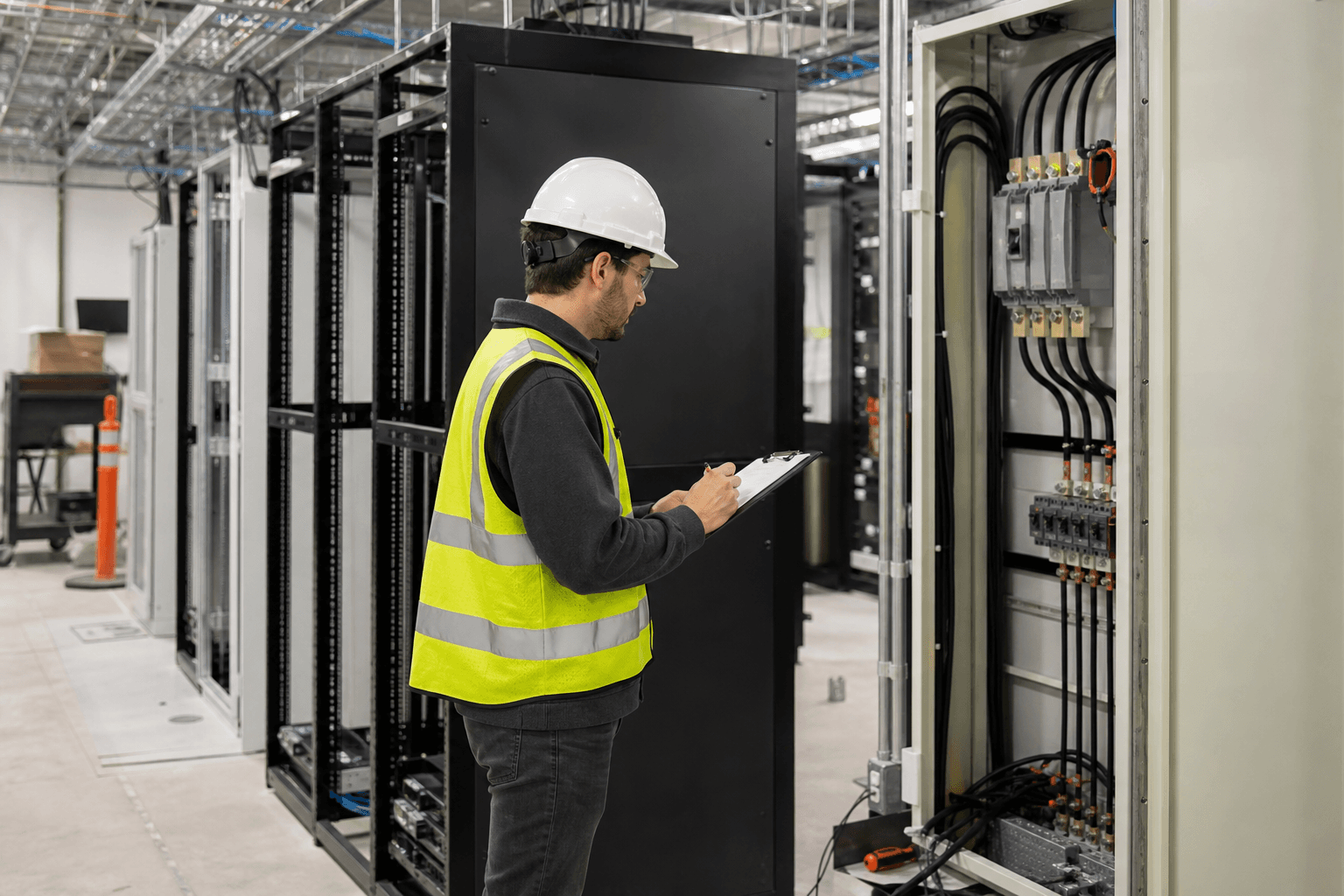
This is why "speed to power" has become a financial metric. It is a revenue-recognition issue wearing a utility helmet.
#The utility trade hiding inside the AI trade
S&P separately reported that global private equity and venture capital investment in utilities rose more than 50% year over year to $69.52 billion in 2025, with data center demand cited as a key driver.
That is the better tell.
Private capital is not only chasing data centers. It is chasing the power system around data centers: generation, grid upgrades, interconnection, and the messy middle where regulated utility timelines meet private-market return targets.
AI may be the demand story. Power timing is the underwriting file.
##Who Benefits If Compute Becomes a Financed Product
Google benefits if TPU capacity can spread faster without every dollar sitting directly on its own balance sheet. Blackstone benefits if AI compute becomes a repeatable infrastructure product with tenant demand deep enough to justify scale.
Customers benefit if they can buy capacity more like a service and less like a bespoke buildout.
The weaker position belongs to anyone selling generic exposure to "AI infrastructure" without controlling the handoff points. A shell developer without power is late. A power project without tenants is speculative. A chip-heavy facility without flexible demand is concentrated risk with better branding.
The Blackstone-Google structure is interesting because it tries to collapse several of those handoffs into one product.
That does not remove risk. It makes the risk easier to price.
##What Investors Should Watch Next
The next phase of AI infrastructure will not be judged only by announced gigawatts or dollar commitments. Announcements are cheap compared with energized capacity.
Watch the dull markers:
permits, substations, tenant concentration, debt terms, delivery dates, and whether customers keep paying for specialized compute after the first wave of model spending cools.
Blackstone's Google deal is a sign that private capital wants to own more than buildings. It wants to own the conversion layer between AI demand and usable compute.
That is a sharper business than being a passive landlord.
It is also a harder one. When the invoice depends on power, chips, networking, software demand, and construction all arriving together, the trade stops looking like easy AI beta and starts looking like project finance with a cloud logo.
#FAQ
Why does the Blackstone-Google TPU cloud matter for investors?
It shows that AI infrastructure is becoming a financed operating product, not just a real-estate lease. Investors need to underwrite delivery timing, tenant quality, and power access alongside AI demand.
Is this mainly a Google Cloud story or a Blackstone story?
It is both. Google contributes the TPU and cloud ecosystem, while Blackstone brings capital, data center scale, and infrastructure ownership experience. The combination matters because AI capacity now requires both balance-sheet depth and physical execution.
What is the biggest risk in this model?
The biggest risk is that capacity arrives late or demand narrows to fewer winning AI platforms. In that case, the asset may still be physically valuable, but the expected compute-service economics can weaken fast.