BKM and Kayne Put $1.81 Billion Behind Small-Bay Industrial Operations

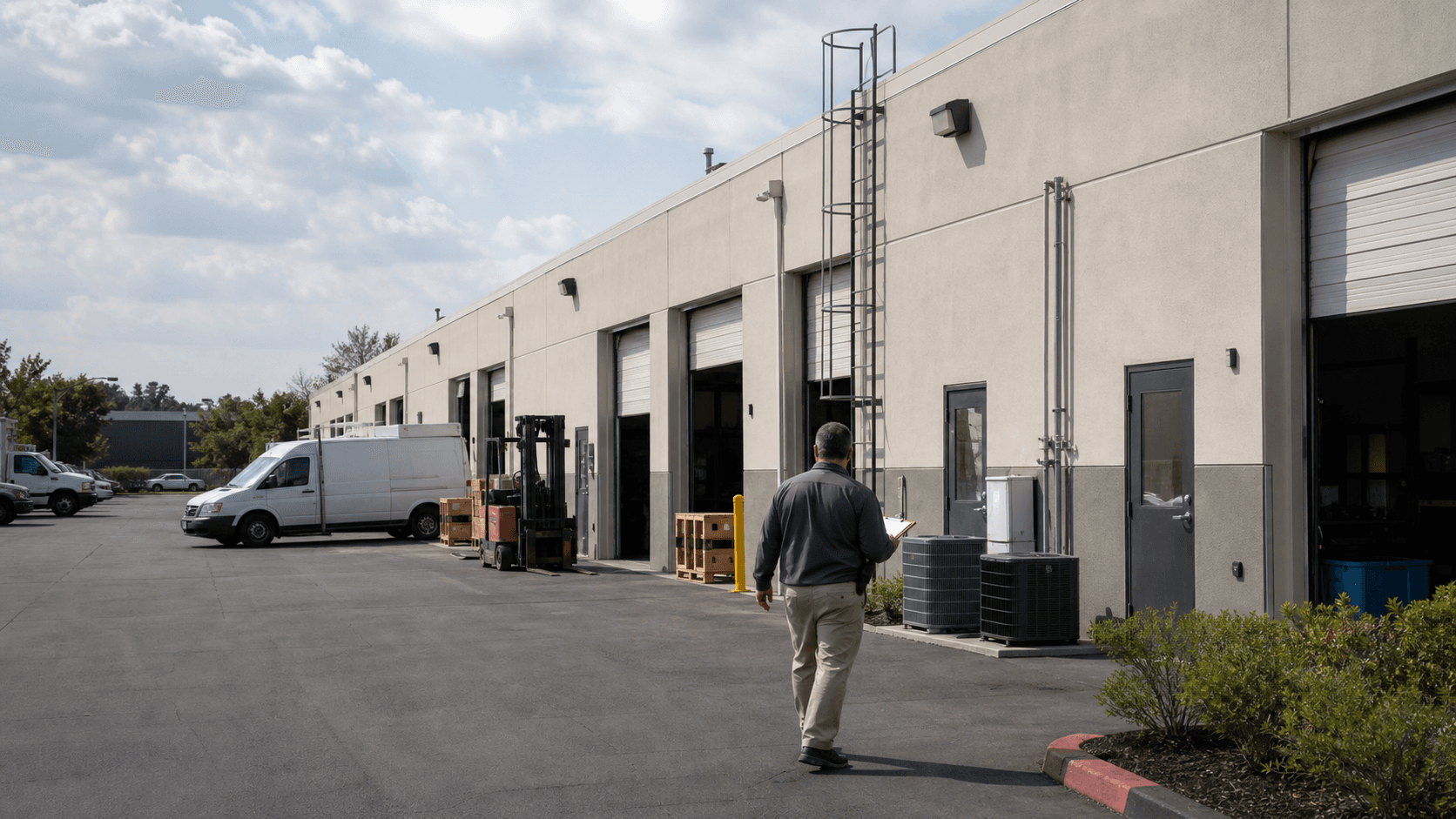
TL;DR: BKM Capital Partners and Kayne Anderson Real Estate bought a $1.81 billion light-industrial portfolio from Link Logistics on June 3, 2026. The obvious story is scale: 8.5 million square feet across 51 properties. The better story is operating control. This deal says institutional real estate capital is moving into the messy, local work of small-bay industrial space, where rent growth depends on roofs, HVAC units, leasing desks, and tenant churn.
##What BKM And Kayne Actually Bought
BKM and Kayne did not just buy warehouses.
They bought nearly 2,000 small units across 275 buildings in California, Washington, Texas, and Georgia. The portfolio is about 90% occupied and comes with eight offices plus 40 employees in property management, leasing, construction, and property accounting.
That employee detail is the tell. In a generic warehouse deal, the market talks about square feet and cap rates. In a small-bay deal, the work is more like running a local service business with real estate attached.
The buyers now manage roughly 15 million square feet through the joint venture. BKM also says the deal brings its platform to nearly 200 employees in 25 offices.
This is not passive rent collection. It is a scale bet on field execution.
##Why Small-Bay Industrial Is Not Big-Box Logistics
The institutional pitch for light industrial sounds clean: infill locations, fragmented ownership, local tenants, limited new supply. The operating reality is less clean.
A small manufacturer may need a roll-up door fixed before a shipment goes out. A plumbing contractor may care more about parking and quick access than a glossy lobby. A vacant unit may need paint, lighting, a repaired roof patch, and less office buildout before it becomes rentable again.
That is why the BKM/Kayne release spends unusual space on the business plan: targeted exterior upgrades, roof and HVAC work, market-ready improvements, and selective reconfiguration. The office buildout target is expected to fall from 37% to 33%.
#The hidden margin line is downtime
For a tenant, downtime is not an abstract real estate problem. It is a missed delivery, a service crew waiting in the lot, or inventory sitting in the wrong place.
For the owner, downtime becomes vacancy, concessions, and maintenance drag. The underwriting question is not simply whether industrial rents rise. It is whether a large owner-operator can make thousands of small tenant decisions faster than a fragmented local landlord base.
That is a harder skill than buying a building.

##Where The Market Context Helps
The timing is not random. Link Logistics said in May that its U.S. industrial portfolio was still seeing solid first-quarter demand, even as the broader warehouse market worked through new supply.
CBRE's shallow-bay research also argued that smaller industrial formats remain tighter than the overall market, with demand tied to small and mid-sized businesses serving local economies. Its March 2026 note said shallow-bay availability remains tight while rents have risen over the past decade.
That contrast matters. Big-box logistics can look cyclical because new supply arrives in large chunks. Small-bay industrial is more annoying to build, more local, and less glamorous. Those are exactly the qualities that make it attractive when capital wants durable cash flow without pretending every property is a trophy asset.
#Scale changes the tenant relationship
At 2,000 units, the owner can start seeing patterns a one-off landlord might miss:
- which units re-lease fastest after a roof or HVAC fix
- which markets justify lower office buildout
- which tenant categories absorb rent increases without leaving
- which maintenance calls predict a renewal problem
That is the real data layer in this deal. It is not an AI dashboard. It is a property manager, a leasing rep, a construction budget, and enough repeated units to make the work measurable.
##Who Pays If The Thesis Is Wrong
Investors should not romanticize this.
Small-bay industrial is still commercial real estate. Debt costs matter. Insurance costs matter. Labor costs matter. Construction costs matter. If local tenants weaken, a 90% occupied portfolio can still become a more expensive machine to run.
JLL's Q1 2026 industrial market work showed national industrial vacancy holding at 7.5%, with leasing improving but not uniformly. That is the environment in which this deal has to work: stabilizing demand, higher operating costs, and capital that cannot count on free-money multiple expansion.
BKM and Kayne are effectively saying the spread is still there if operations are good enough.
That is a bold but plausible claim. The risk is that the market may reward the idea of small-bay scarcity faster than managers can actually convert vacant suites, reduce office-heavy layouts, and retain local tenants without spending too much money.
##Why This Belongs On A Finance Desk
This is not just a real estate transaction. It is a capital-allocation signal.
The last commercial real estate cycle trained investors to chase simple labels: office bad, industrial good, data centers amazing, retail complicated. The BKM/Kayne deal is a reminder that labels are too blunt.
The asset class may be light industrial, but the financial mechanism is operating leverage through local execution. If the platform works, every repaired roof, every faster lease-up, and every better tenant handoff can show up as net operating income. If it does not, scale just makes the problems easier to count.
That is what makes the deal interesting. Institutional capital is not merely buying a hot sector. It is buying the right to prove that boring property work can be organized into a repeatable margin engine.
#FAQ
What did BKM and Kayne Anderson Real Estate buy?
They acquired a $1.81 billion portfolio from Link Logistics with 8.5 million square feet, 51 multi-tenant light-industrial properties, nearly 2,000 units, and about 90% occupancy.
Why does small-bay industrial matter for investors?
Small-bay industrial serves local manufacturers, service businesses, contractors, and logistics users. Its scarcity can support rents, but the investment case depends heavily on maintenance, leasing speed, tenant retention, and local property management.
What is the main risk in the deal?
The risk is that operating costs, tenant churn, debt costs, or weaker local business demand eat the spread. In this sector, scale only helps if the owner can turn field-level work into higher net operating income.