REPAY's KUBRA Deal Turns Utility Bills Into A Payments Toll Road

TL;DR: REPAY closed its $372 million cash acquisition of KUBRA, creating a larger consumer bill-payment platform across utilities, government, and insurance. The business implication is not simply "more payments volume." REPAY is buying a place inside boring, recurring household obligations, where bill presentment, reminders, payment processing, and customer communications can become one sticky infrastructure layer. The catch is leverage: this toll road only works if integration savings arrive before debt costs eat the story.
##What REPAY Actually Bought
REPAY said it completed the KUBRA acquisition for $372 million in cash, after announcing the agreement on March 30, 2026.
The headline sounds like another payments deal. It is more specific than that.
KUBRA sits in the unglamorous handoff between large billers and households: utility bills, government payments, insurance communications, payment notifications, and customer-service workflows. REPAY says the combined platform will reach over 40% of U.S. and Canadian households every month and process more than $130 billion in combined annual payment volume.
That is the part investors should not skim past.
Card swipes are discretionary. Utility bills are not. The payment processor that gets embedded into those recurring obligations is not just chasing checkout volume; it is trying to own a tiny operational toll on bills people have to pay.

##Why The Boring Bill Is The Product
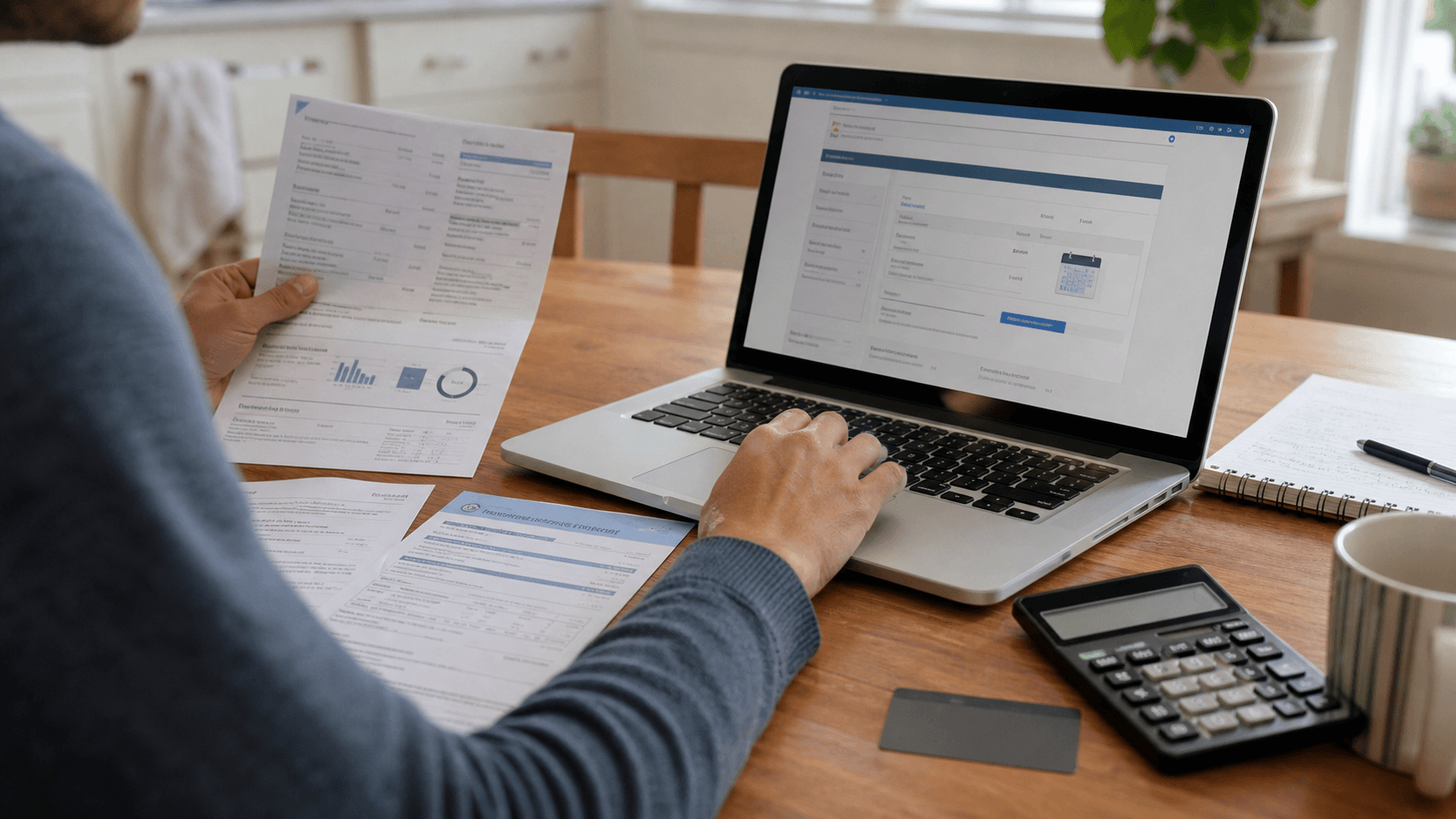
The ordinary household scene is the point: a laptop on the kitchen table, a utility notice, a debit card, a due date, and one more password reset that nobody wanted.
For the consumer, that is a chore. For a biller, it is a cost center. For a payments company, it is a repeatable workflow with several monetizable handoffs:
- presenting the bill clearly enough that it gets paid;
- nudging the customer before the due date;
- routing the card, ACH, wallet, or other payment method;
- handling exceptions, failed payments, refunds, and customer notifications;
- giving the utility, municipality, or insurer cleaner data on payment behavior.
That is why KUBRA matters. It is not merely a gateway sitting at the end of the transaction. It is closer to the communication and billing surface, where the customer decides whether to pay now, schedule payment, call support, or fall into delinquency.
#Why non-discretionary volume is different
Payments investors often love volume, then learn the hard way that not all volume has the same bargaining power.
A restaurant ticket, an online purchase, and a utility bill may all become payment transactions, but the buyer psychology is different. The utility bill is tied to service continuity. The government payment is tied to compliance. The insurance payment is tied to coverage.
That gives REPAY a cleaner story than "consumer spending is strong." It is a bet that the pipes under household obligations are still worth paying for even when the consumer gets more cautious.
##Where The Financial Test Shows Up
REPAY's updated outlook tells the market what has to happen next. The company now expects 2026 revenue of $490 million to $500 million and adjusted EBITDA of $168.5 million to $176 million after adding KUBRA for the remaining seven months of the year.
KUBRA is expected to contribute $150 million to $154 million of revenue and $27.5 million to $30 million of adjusted EBITDA during that same remainder-of-2026 period.
Those are useful numbers, but the more revealing line is leverage. REPAY said combined net leverage at closing is about 4.0x and expects to reduce it below 3.0x within 18 months. The company also received a $500 million senior secured term loan and a $100 million undrawn revolver.
This is where the acquisition stops being a fintech slide and becomes a balance-sheet job.
#The margin is in the integration work
REPAY previously framed the deal as creating a scaled consumer bill-payment provider, with combined 2025 revenue and adjusted EBITDA of about $548 million and $178 million, respectively.
Scale is nice. Scale with debt is less forgiving.
The company is targeting $15 million-plus of annual run-rate cost synergies and $5 million-plus of technology savings over three years, plus about $5 million of revenue opportunities by 2028. Those are not decorative numbers. They are the bridge between "we bought a bigger platform" and "we can make the capital structure less tense."
If platform consolidation gets delayed, the market will not care that the end market is boring. Boring revenue can still disappoint when it is financed with ambitious debt math.
##Who Gains Pricing Power
The most interesting winner is not necessarily the consumer. A smoother bill-payment experience is useful, but the consumer is not choosing a payments vendor the way she chooses a brokerage app.
The real buyer is the utility, municipality, insurer, or large biller that wants fewer support calls, fewer failed payments, better digital adoption, and cleaner customer messaging.
That puts REPAY in a more useful sales conversation. It can sell not just payment acceptance, but the reduction of operational friction around recurring bills.
In a utility back office, the daily pain is not abstract. Someone is reviewing failed payment files, call-center queues, mailed notices, payment-plan exceptions, and customer communication rules. If one vendor can reduce that mess while capturing the payment flow, it has a better claim on the budget than a pure processor with a slightly cheaper rate.
##What The Market May Be Missing
The easy read is that REPAY bought volume. The sharper read is that REPAY bought distribution inside bills that households do not get to ignore.
That does not make the deal automatically good. It makes the test more precise.
REPAY has to prove three things:
- KUBRA's client relationships stay intact after the ownership change.
- The combined platform can cross-sell without creating implementation drag for utilities, government entities, and insurers.
- Debt paydown happens from real cash generation, not just from synergy language.
The business model is attractive because the payments are recurring. The risk is that the integration work is recurring too.
For a payments company, the cleanest fee is the one attached to a bill the customer was going to pay anyway. REPAY just bought deeper access to that bill. Now it has to show that access is worth more than the leverage used to get it.
#FAQ
What did REPAY buy from KUBRA?
REPAY bought KUBRA Data Transfer LTD., a billing, payments, customer communication, and experience-management platform serving large utility, government, and insurance clients across North America.
Why does this matter for investors?
The deal moves REPAY deeper into non-discretionary consumer bill payments, where recurring obligations can create stickier payment volume than ordinary retail spending. The investor test is whether that stickiness offsets integration risk and higher leverage.
What is the main risk?
The main risk is execution under debt. REPAY expects leverage to fall below 3.0x within 18 months, but that depends on keeping KUBRA clients, capturing savings, and converting the larger platform into cash flow.