AI Inference Is Becoming a Real-Estate Trade

A lot of investors still talk about AI infrastructure as if the whole game lives inside Nvidia’s income statement. That is already too narrow. The more interesting trade is slipping one layer down, into ordinary buildings with enough power, fiber, and local proximity to run AI where people actually use it.
That is why I Squared Capital’s move this week matters more than its $225 million price tag. It agreed to buy 10 data center facilities from Cogent and use them to seed a new U.S. colocation and AI inference platform with up to $1 billion behind it. The headline sounds like another infrastructure deal. The hidden point is sharper: AI inference is turning boring telecom real estate into scarce financial inventory.
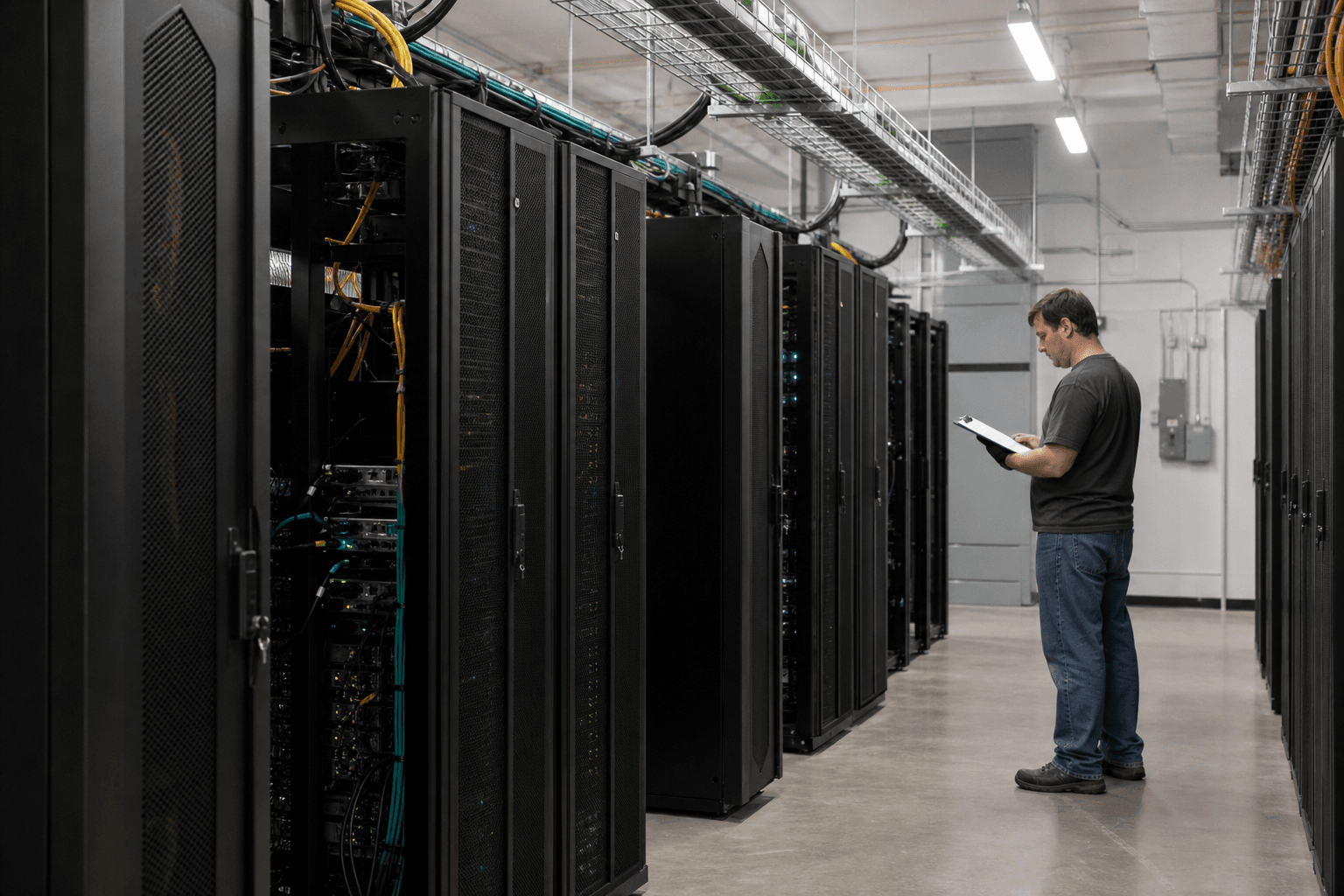
One scene sits inside the deal itself. These are not fantasy campuses in the desert with years of permitting still ahead. They are existing facilities in markets like Chicago, Atlanta, Phoenix, Houston, Nashville, and the Baltimore area, with about 53 megawatts of installed power and roughly 259,000 square feet already in place.
The other scene is the one capital allocators are now staring at: a map, an interconnection queue, and a calendar. If training clusters rewarded whoever could build the biggest fortress, inference rewards whoever can get usable capacity near customers without waiting forever for the perfect site.

That distinction matters because inference is a different business from training.
Training can justify concentration. A few giant campuses, massive upfront capex, and long procurement cycles make sense when the goal is to build the model. Inference is messier. It happens closer to enterprise workflows, consumer applications, latency-sensitive services, and the day-to-day traffic that actually monetizes AI.
So the asset changes. The scarce thing is not just a GPU. It is a facility that already has power, cooling potential, carrier access, and the right geography. In that world, an old colocation room starts behaving less like a legacy telecom asset and more like an option on future compute demand.
That is what many public-market investors are still underestimating. They keep treating AI infrastructure as a semiconductor story plus a hyperscaler capex story. It is both of those things, but it is also becoming a salvage-and-upgrade story.
The winners will not only be the companies that manufacture the best chips. They will also be the owners and financiers of “good enough, right now” infrastructure:
- Facilities that can be upgraded faster than a greenfield campus can be permitted
- Sites close enough to population and network exchange points to make inference useful, not theoretical
- Operators that can turn modest legacy assets into liquid-cooled, high-density capacity without rebuilding from scratch
This is where the deal gets interesting as a market signal instead of a one-off transaction.
Cogent is effectively monetizing a set of data center assets that fit less neatly with its core network identity. I Squared is doing the opposite. It is buying a bundle of existing constraints and re-pricing them as growth assets because AI has changed what “obsolete” infrastructure looks like.
That is a very private-markets way of reading the moment. When the public market obsesses over the next model release, infrastructure capital starts asking a colder question: which ugly assets can be repositioned into unavoidable bottlenecks?
It is the same logic that shows up in warehouses during an e-commerce surge or apartment conversions in a tight housing market. Once demand arrives faster than new supply, the premium shifts toward anything already standing that can be adapted with less friction than starting over.
For AI, that means the next tranche of value may come from conversion economics rather than pure invention. How much time can you save? How much power is already wired? How much fiber is already lit? How much permitting pain can you skip?
Those questions sound operational. They are really financial. They determine who captures rent when every cloud provider, enterprise software company, and inference-heavy application team wants capacity before the utility timeline catches up.
This is also why the AI buildout is starting to look more like infrastructure private equity and less like classic software investing.
Software people instinctively ask who has the smartest model. Infrastructure money asks who controls the site, the switchgear, the cooling retrofit, the lease, and the interconnection. One mindset chases intelligence. The other monetizes delay.
My bet is that the second mindset will matter more over the next leg of the cycle than most equity narratives admit.
If AI keeps moving from spectacular demos into ordinary business workflows, the highest-return asset may not be the most glamorous server cluster. It may be the plain building in the right zip code that can say yes six quarters sooner than everyone else.