Copper's Pullback Is Still A Working-Capital Problem For U.S. Buyers


TL;DR: Copper fell after a stronger U.S. jobs report pushed the dollar higher and revived rate-hike fears, but the real business story is not a one-day commodity wobble. Copper remains expensive, tariff-sensitive, and hard to substitute in electrical, construction, and industrial supply chains. For U.S. buyers, the hidden cost is a procurement market where timing, import exposure, and inventory discipline matter almost as much as the metal price.
##What Copper's Pullback Actually Changed
Copper prices dropped to a one-week low on Friday after the dollar strengthened and traders reacted to a stronger U.S. jobs report, according to a Reuters market report carried by Business Recorder. That sounds like a normal macro trade: stronger dollar, higher-rate fear, weaker metals.
But copper is still not cheap. Reuters noted copper was up 9% for the year and had touched a record high of $14,527.50 in January.
That is the part that matters for U.S. companies. A pullback from a record is not the same thing as relief.
##Why The Copper Story Is A Procurement Story
Copper is used in power equipment, construction, air-conditioning systems, data center electrical work, autos, and factory machinery. A CFO does not experience that as a neat LME chart. The CFO sees it as a quote that expires quickly, a supplier asking for escalation language, and a project manager trying to decide whether to lock in materials before the next pricing reset.
The market headline says copper fell. The operating desk says the bid is still uncomfortable.
#How a price dip can still hurt margins
The awkward part is that copper's price signal is getting mixed with trade policy. Section 232 metals rules have already changed the way steel, aluminum, and copper imports are treated; KPMG summarized the 2026 changes as applying a 50% tariff to goods made entirely or almost entirely of steel, aluminum, or copper, with different treatment for derivative products.
That creates a spread between "copper is down today" and "my landed copper cost is down." Those are not the same sentence.
For a U.S. contractor or manufacturer, the risk is not just the global benchmark. It is the landed-cost stack:
- the metal price
- the dollar
- tariff classification
- freight and warehouse timing
- supplier quote windows
- the customer's willingness to accept a surcharge
That is why a one-day selloff can still leave buyers feeling boxed in.
##Where The Real Cost Shows Up
Picture a procurement manager at a regional HVAC distributor staring at two screens. One has commodity prices. The other has supplier emails for copper tubing, replacement coils, and electrical components.
The Reuters chart says copper backed off. The supplier email says the quote is valid for 48 hours.
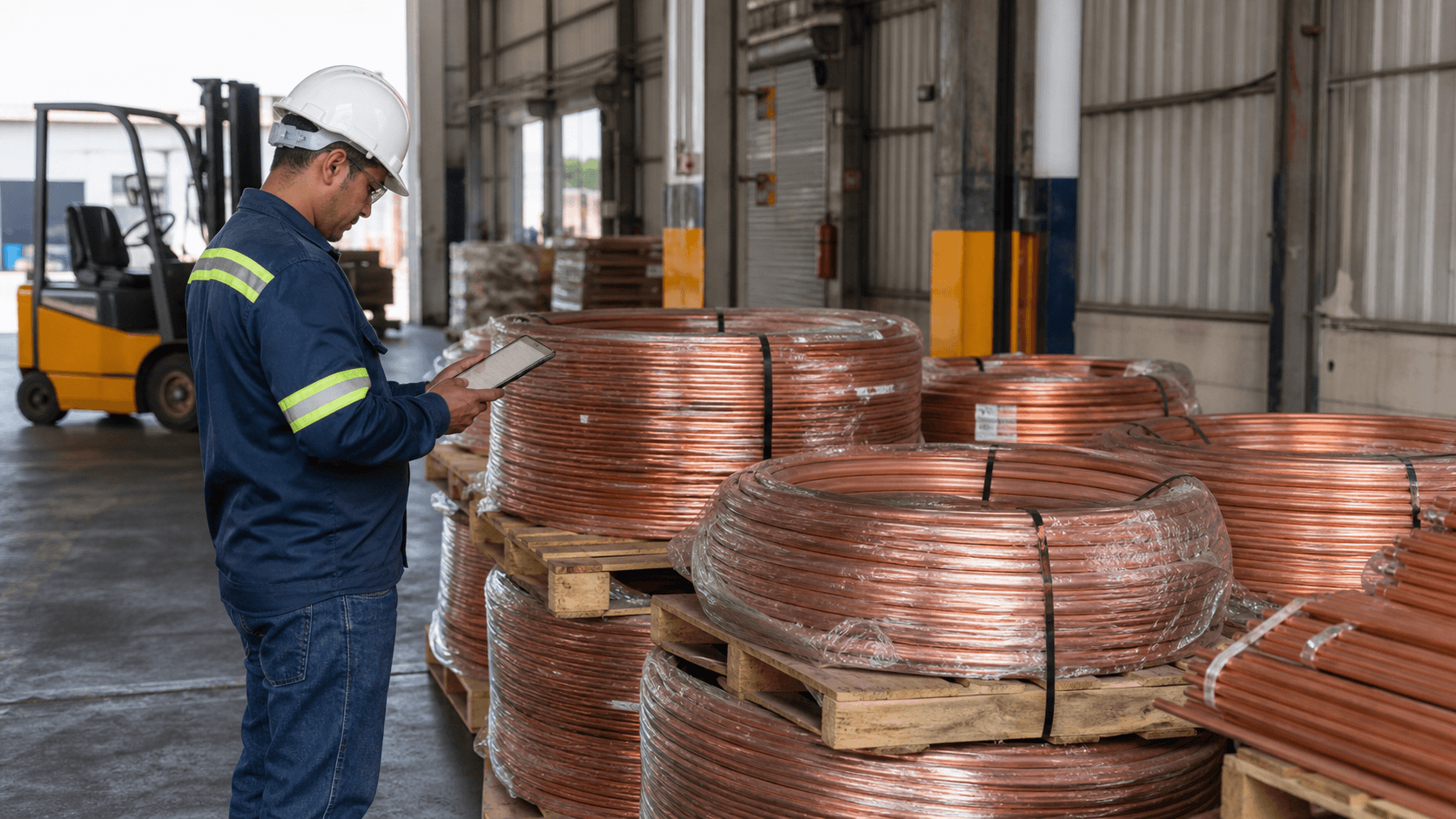
That is where the market becomes a business-model problem. If the distributor waits, it may catch a better metal price. If it waits too long, a tariff classification change, shipping delay, or supplier surcharge can erase the benefit. If it buys aggressively, it protects customer commitments but ties up cash in inventory.
#Why this is different from ordinary inflation
Ordinary input inflation is annoying but familiar. A company raises price, compresses margin, or accepts a smaller order book.
Copper inflation is harder because it sits inside long projects and regulated or semi-contracted workflows. A utility job, apartment retrofit, factory upgrade, or data center electrical package does not always allow instant repricing. The buyer may have signed the customer before the materials desk signed the copper.
That makes copper less like a commodity trade and more like a working-capital test.
##Who Has Pricing Power
The winners are not automatically copper miners or metal traders. The better-positioned companies are the ones with enough scale, supplier access, and balance-sheet room to avoid panic buying.
A large industrial distributor can carry more inventory and negotiate better pass-through terms. A smaller contractor may have to quote jobs with wider contingencies or eat the difference when a customer refuses a surcharge.
The losers are the businesses that sell fixed-price work while buying variable-cost materials.
This matters for investors because input volatility does not hit every company at the same speed. It first appears in gross margin, then in working capital, and then in customer behavior. A project delayed because copper costs are uncertain is not just a commodity story. It is revenue timing.
##Why Rates Still Matter
The jobs report matters because copper is also a rate-sensitive asset. When stronger labor data pushes traders toward higher-for-longer Fed expectations, the dollar can rise and global metals can weaken. CME's FedWatch Tool is the daily scoreboard for that repricing.
But for companies, rates create a second pressure point: inventory finance.
Buying copper early is more expensive when cash earns something and credit costs more. Holding extra coils, tubing, and electrical materials is a hedge, but it is also capital trapped on a shelf.
That is the overlooked piece. Copper's high price is not only a cost-of-goods problem. It is a balance-sheet problem hiding inside a warehouse.
##What Investors Should Watch
The cleanest signal is not whether copper has a green or red day. It is whether companies can pass through the full landed cost without slowing orders.
Watch the language in industrial, construction, HVAC, electrical distributor, and utility-supplier earnings calls. The useful words will not be dramatic. They will be plain:
"inventory normalization," "project timing," "surcharge," "price-cost," "tariff impact," "customer pushback."
If those phrases start clustering, copper is no longer just a macro input. It is a margin argument.
The twist is that a copper pullback can make the market feel calmer while the buyer still has no clean choice. Wait and risk the quote. Buy and fund the warehouse. Pass it through and test the customer.
That is not relief. That is a different form of pressure.
#FAQ
Why did copper fall after the U.S. jobs report?
Copper fell because stronger labor data supported the dollar and renewed concern that the Federal Reserve may keep rates higher or even hike. A stronger dollar often pressures dollar-priced commodities by making them more expensive for non-U.S. buyers.
Why does copper matter for U.S. business margins?
Copper sits inside power, construction, HVAC, manufacturing, and electrical supply chains. Companies that sell fixed-price work but buy copper-linked materials at variable prices can see margin pressure even when end demand is stable.
What is the unique investor takeaway?
Do not read copper only as a mining or macro trade. For many U.S. companies, copper is a landed-cost and working-capital problem, especially when tariffs, supplier quote windows, and higher financing costs all hit the same procurement desk.