The AI Buildout Is Becoming a Field-Services Business

TL;DR: Dycom's record quarter is a useful reminder that the AI infrastructure boom is no longer just a chip story or a cloud-rental story. It is becoming a field-execution story. When Dycom reports record backlog of $11.9 billion and says demand for fiber infrastructure and data-center builds is stronger than ever, the market should hear something simple: the next margin pool in AI may sit with the companies that can actually connect racks, power, fiber, and buildings on schedule.
The easy version of AI capex still fits on one slide. Nvidia sells the expensive silicon. Cloud platforms rent the capacity. Everyone else tries to catch a valuation draft.
The harder version starts in a project trailer.
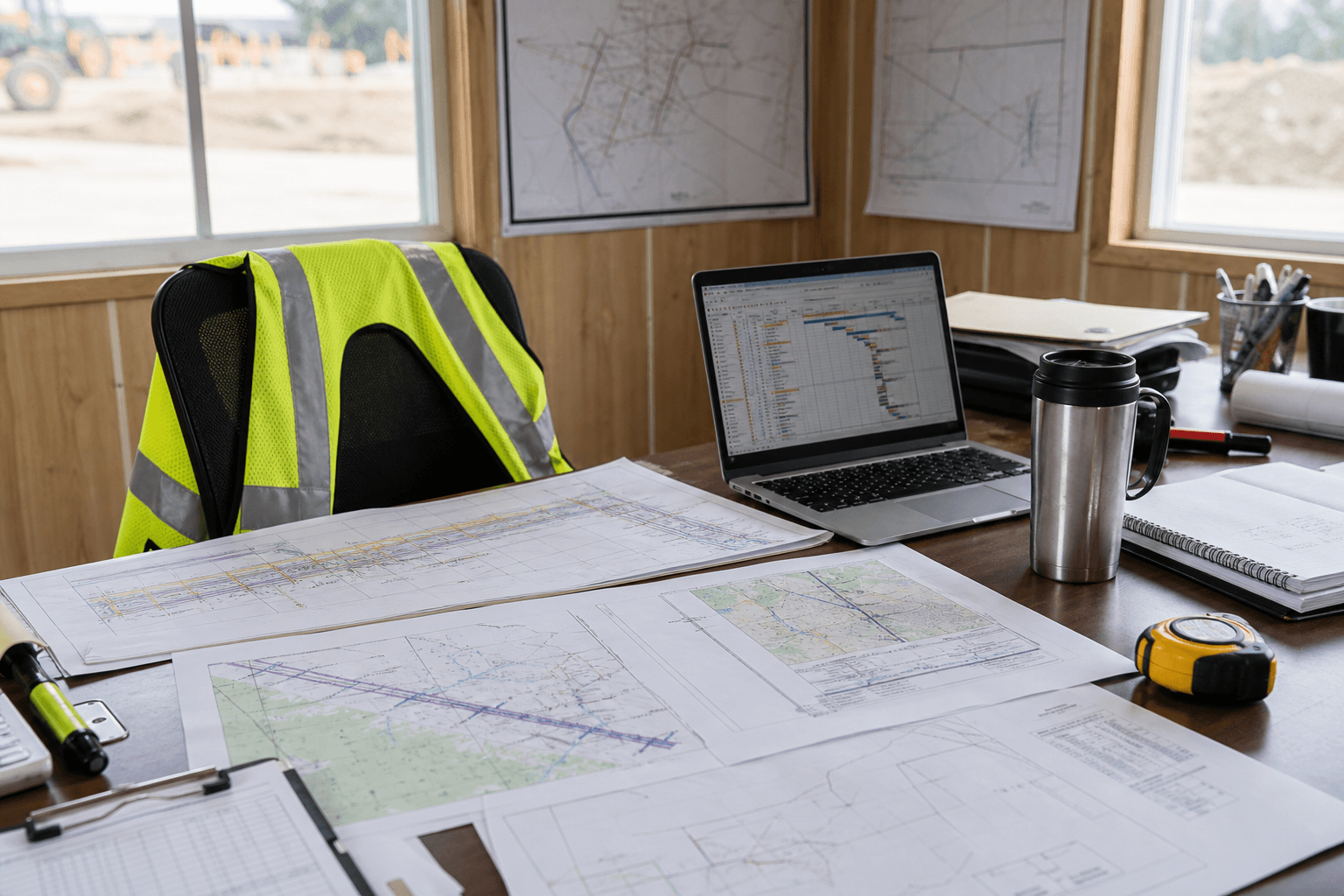
A superintendent is looking at route maps, subcontractor schedules, trenching windows, structured-cabling plans, and a customer deadline that does not care whether the bottleneck is a GPU, a transformer, a fiber crew, or a permit. That is where this market is heading.
##Why Dycom Matters More Than It Sounds
Dycom's May 27 release was not subtle. Contract revenue rose 56.1% to $1.965 billion. Total backlog climbed 46.5% to $11.906 billion. Management raised full-year fiscal 2027 revenue guidance to $7.38 billion to $7.65 billion.
That is a big number for a business many investors still file under "contractor."
The more revealing detail came in the company's own language. Dycom said demand for fiber infrastructure and data-center builds is "more robust today than it has ever been," and its investor presentation said customers are proactively extending contract durations to lock in skilled workforce capacity and hit long-term build goals.
That is not normal cyclical demand. That is reservation behavior.
##The Constraint Has Moved Outside The Rack
For the past year, the market has mostly tracked AI scarcity through chips, power, and big data-center leases. Those are real bottlenecks. They are just not the only ones anymore.
Dycom's business sits in the physical handoff layer between abstract AI spending and usable infrastructure: planning, engineering, aerial and underground construction, fiber deployment, and now more inside-the-building digital infrastructure work.
Its conference materials make the point even more clearly. The company says its acquisition of National Technology Integrators extends Dycom from server-rack connections all the way through the networks linking data centers, facilities, businesses, and homes across America.
That is why this quarter matters.
AI infrastructure is turning into a continuity business. The value is shifting toward the firms that can carry a build from the rack to the road, and from the road to the user, without losing time in the middle.
##The New AI Trade Looks More Like Industrial Project Finance
Reuters gave a separate clue two days earlier. I Squared Capital said it bought 10 data-center facilities from Cogent Fiber for $225 million and plans to commit another $1 billion to upgrades, expansions, and acquisitions. The logic was not just more training capacity. It was inference capacity closer to end users, with power and connectivity already in hand.
That shift matters because inference spreads the AI buildout into more places and more workflows. Training can stay concentrated. Inference wants to live closer to customers, enterprises, and latency-sensitive workloads.
Once that happens, the winning skill is not only designing the best chip or raising the largest capex budget.
It is executing repeated builds in constrained local markets.
That means crews. It means routing. It means inside-plant cabling. It means power coordination. It means somebody showing up on time with the right equipment and enough trained labor to keep a multimillion-dollar site from idling.
#The hidden premium is execution certainty
That is the business-model shift the market still underprices.
When customers start extending contracts to secure workforce availability, they are not just buying construction hours. They are buying schedule certainty. In an AI buildout, schedule certainty is a financial product.
Every delayed handoff can strand expensive equipment, postpone customer revenue, and widen the gap between committed capex and monetized capacity.
The contractor who removes that risk stops looking like a commoditized vendor.
##Why This Is A Better Read Than Another Chip-Stock Take
Chip stories are crowded. Everybody already knows the headline version.
The more interesting question is where scarcity becomes boring enough to be durable.
Dycom's results suggest the next durable shortage may be competent deployment at scale. Not glamorous. Not tweetable. But financially important.
That also explains why backlog deserves more respect here than usual. In plenty of industries, backlog can be a soft number. In this case, backlog paired with multi-year fiber programs, data-center construction, and workforce lock-ins starts to look like proof that customers are trying to reserve execution capacity before it gets tighter.
The article of faith in AI has been that demand will trickle down from the model layer into the rest of the economy. It already is. It is just arriving through concrete, cable trays, low-voltage engineering, and field labor before many investors notice.
##What To Watch Next
The clean follow-up indicators are practical:
- Whether digital-infrastructure contractors keep reporting longer contract duration and stronger next-12-month backlog.
- Whether more acquisitions look like Dycom's NTI deal, adding inside-building and rack-adjacent capabilities rather than just headline scale.
- Whether inference-oriented capital keeps favoring facilities with existing power and connectivity over greenfield fantasy projects.
If those signals hold, the next AI winners will not all be software names or chip designers.
Some of them will be the companies standing in muddy boots between a press release and a live workload.
That is usually where a boom becomes an industry.
#FAQ
Why is Dycom relevant to AI investors?
Because AI infrastructure only earns money once power, fiber, and building systems are actually connected and operating. Dycom's results show that field execution is becoming its own scarce layer of the stack.
What is the core Gainbrief takeaway?
The AI buildout is becoming a field-services business. Skilled labor, network deployment, and project delivery are starting to behave like reserved capacity, not generic contractor supply.
Is this just a telecom story in disguise?
No. Dycom's newer building-systems work and the NTI acquisition point directly at data-center and inside-plant digital infrastructure, while Reuters' I Squared deal shows capital moving toward inference facilities that need exactly this kind of physical execution.