Novartis's Actinium Cancer Data Turns Isotope Supply Into the Business Test

TL;DR: Novartis used fresh May 31 ASCO data to push radioligand therapy deeper into prostate cancer, but the business story is not just another promising oncology readout. If actinium-based drugs scale, the scarce asset may be isotope supply, treatment scheduling, and nuclear-medicine capacity. That turns a drug launch into a logistics and capital-allocation test for Novartis, hospitals, suppliers, and rival pharma buyers.
##What Novartis Put on the Table at ASCO
Novartis's latest radioligand update has two pieces that investors should not collapse into one headline.
First, the company said Pluvicto improved radiographic progression-free survival across key metastatic hormone-sensitive prostate cancer subgroups, with the earlier primary result showing a 28% reduction in the risk of radiographic progression or death.
Second, an experimental actinium-based drug showed early anti-tumor activity in prostate cancer. A Reuters report carried by MarketScreener said the 101-patient study showed PSA levels fell by at least half in 52.5% of patients previously treated with Pluvicto, with higher response rates in patients who had not received Pluvicto.
That sounds like a clinical story. It is also a capacity story.
##Why the Scarce Asset May Not Be the Molecule
Most drug stories are easy to narrate: trial works, label expands, sales rise, competitors respond.
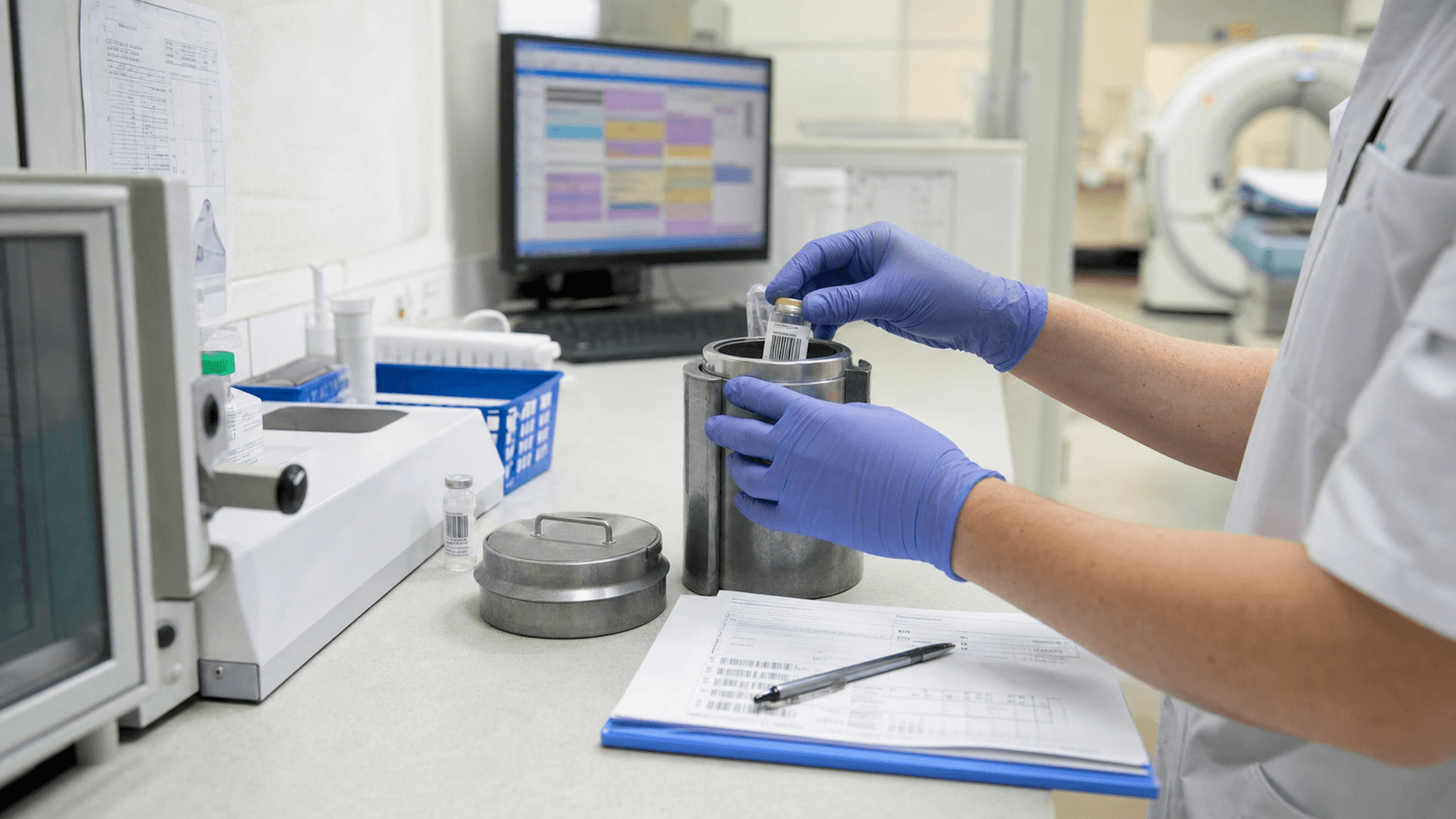
Radioligand therapy is messier. The product is not just a vial. It is a radioactive isotope attached to a targeting molecule, routed through a hospital workflow that has to handle dosing, radiation safety, scheduling, reimbursement, specialist labor, and patient throughput.
That makes the business model feel less like a normal pill launch and more like a specialized operating system for oncology.
#Why actinium changes the cost stack
Pluvicto uses lutetium-177. Novartis's experimental program uses actinium-225, an alpha emitter. The clinical pitch is more concentrated radiation over a shorter distance.
The commercial catch is that actinium-225 is not ordinary input inventory.
Supply has been tight enough that Novartis already signed a long-term actinium-225 supply agreement with Niowave, a U.S. medical-isotope producer that said it planned to expand production capacity in Lansing, Michigan. That is not a footnote. It is the hidden procurement line behind the next oncology margin pool.
##Where the Business Test Shows Up
Picture the less glamorous part of this market: a nuclear-medicine desk at a hospital trying to line up a patient slot, a dose delivery, a specialist team, and a payer authorization window.
If one part slips, the asset is not just delayed. It decays, the room sits idle, the patient gets rescheduled, and the economics leak out through operations rather than price.

That is why Novartis's radioligand bet should be judged on more than response rates. The question is whether the company can turn clinical promise into repeatable throughput.
The winners in this category will need to control several handoffs:
- Isotope supply that can scale without surprise shortages.
- Manufacturing and shipment timing that matches treatment windows.
- Hospital capacity in nuclear medicine, imaging, and infusion workflows.
- Reimbursement processes that do not strand expensive doses in administrative limbo.
- Safety management that keeps side effects and radiation protocols predictable enough for broader use.
This is where the investor lens should shift from "oncology pipeline" to "healthcare infrastructure."
##Who Has Pricing Power if Radioligands Scale
Novartis already has proof that this is not a science project. Its 2025 product-sales table shows Pluvicto generated $1.994 billion in annual net sales, up 43% in reported dollars.
Reuters also reported that Pluvicto and Lutathera together brought in $2.8 billion last year, while radioligand therapies now account for nearly 40% of Novartis's cancer R&D investments.
That is the tell. A company does not put that much oncology R&D weight behind a modality unless it believes the platform can become larger than one asset.
#The rival response will not only be clinical
Eli Lilly, Bristol Myers Squibb, Bayer, and AstraZeneca have all moved into radiopharma through acquisitions or development programs. The obvious race is for better targets and better data.
The less obvious race is for the boring stuff: isotope contracts, production slots, site readiness, physician familiarity, imaging workflows, and payer comfort.
In ordinary biotech, a smaller company can surprise a giant with a clever molecule. In radiopharma, the surprise has to survive logistics.
##Why This Belongs on the Finance Desk
The clean bull case is that Novartis is building a durable oncology platform where clinical efficacy, isotope supply, and hospital workflow reinforce one another.
The clean bear case is that the same complexity becomes a ceiling. Side effects such as dry mouth and anemia, flagged by analysts in the Reuters report, still need larger-trial clarity. Earlier-line use may widen the market, but it also raises the operating standard.
That is the tension. Radioligand therapy can look like a premium oncology franchise and still behave like a constrained industrial network.
For investors, the mistake is treating actinium data as a simple "more effective drug" headline. The better question is whether Novartis can make the radioactive supply chain boring enough for Wall Street to underwrite.
##What to Watch Next
The next important signal is not just another abstract or hazard ratio.
Watch for evidence that the system is getting easier to operate:
Can isotope suppliers add capacity on schedule? Can hospitals expand treatment slots without bottlenecks? Can Novartis keep safety manageable as trials move earlier? Can payers process this as a repeatable care pathway instead of a boutique intervention?
If yes, actinium is not just a clinical upgrade. It is a new kind of oncology operating leverage.
If no, the molecule may work while the business model queues at the radiopharmacy door.
#FAQ
Why does Novartis's actinium data matter for investors?
It suggests Novartis may extend radioligand therapy beyond Pluvicto into a broader prostate-cancer platform, but the investment case depends on supply, treatment capacity, safety, and reimbursement as much as efficacy.
What is the main bottleneck in radioligand therapy?
The bottleneck is the full operating chain: scarce isotopes, specialized manufacturing, time-sensitive delivery, nuclear-medicine capacity, payer approval, and patient scheduling. A good drug still needs a reliable treatment system.
Is this mainly a healthcare story or a business story?
It is both. The medical data creates the opportunity, but the commercial upside comes from turning radioactive oncology treatments into a scalable, repeatable workflow.